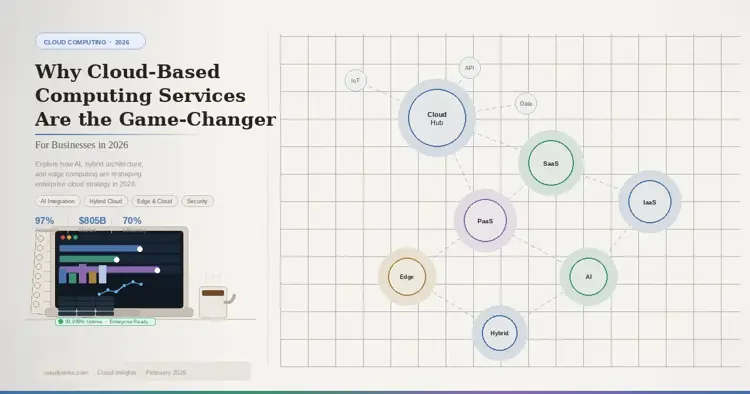
Why Cloud-Based Computing Services Are the Game-Changer for Businesses in 2026
Naapbooks Insights • Cloud Computing • 5 min read
The 2026 Digital Imperative: Why Cloud is Non-Negotiable
In 2026, cloud-based computing services have evolved from competitive advantage to business necessity. Organizations recognize that cloud adoption determines survival in an AI-driven marketplace. The question has shifted from "Should we move to the cloud?" to "How fast can we complete our transformation?"
Enterprise cloud adoption exceeds 97%, with global spending surpassing $805 billion annually. Businesses leveraging cloud infrastructure consistently outpace competitors in innovation, efficiency, and market responsiveness.
The Evolution of Cloud Computing: From Infrastructure to Intelligence
The Journey from On-Premise to Cloud-Native
A decade ago, organizations relied on physical servers housed in costly data centers. This legacy approach demanded substantial capital investment, ongoing maintenance, and offered minimal scalability. IT teams spent countless hours managing hardware instead of driving innovation.
Today's landscape is dramatically different. Modern businesses operate with unprecedented agility, deploying global infrastructure in minutes rather than months.
Understanding Cloud Service Models
Modern cloud-based computing services deploy across three primary models:
SaaS vs PaaS vs IaaS represents different levels of control and responsibility:
- Software as a Service (SaaS): Fully managed applications like Microsoft 365 and Salesforce
- Platform as a Service (PaaS): Development frameworks such as Google App Engine accelerating deployment
- Infrastructure as a Service (IaaS): Virtual resources from AWS, Azure, and Google Cloud offering maximum customization
Modern Cloud Architecture Options
Organizations strategically deploy across multiple architectural models to optimize performance and cost.
Public cloud and private cloud, offer different trade-offs. Public clouds deliver shared resources with cost efficiency and global reach. Private clouds provide dedicated infrastructure with enhanced security and compliance.
The transformation happens through hybrid cloud architecture, seamlessly integrating on-premises infrastructure with public cloud resources. This enables businesses to optimize workload placement based on performance, security, and cost. Multi-cloud strategy adoption accelerates as organizations leverage multiple providers to maximize resilience, avoid vendor lock-in, and access best-of-breed services.
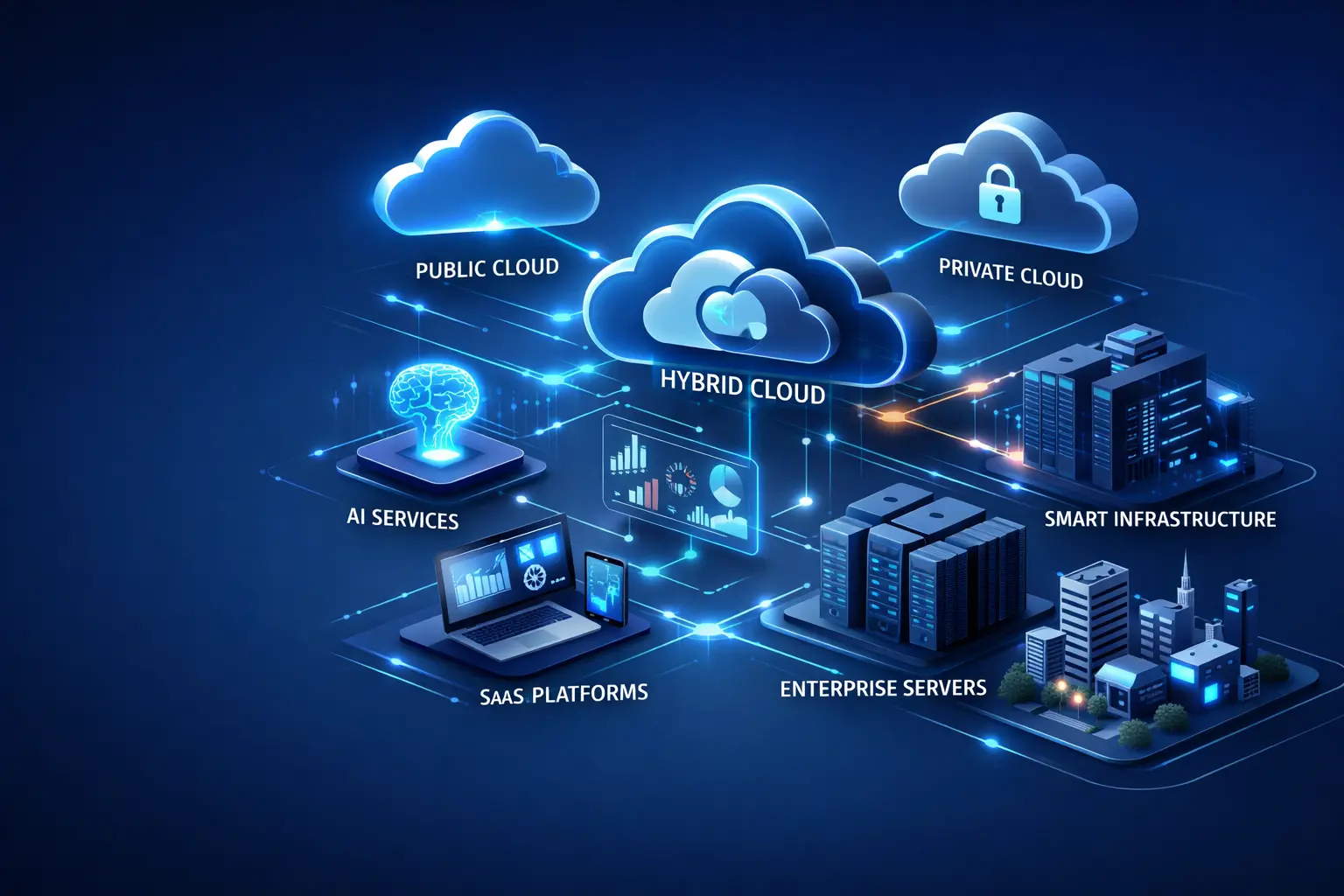
How Cloud Computing Transforms Business Operations in 2026
1. Cost Efficiency and Cloud Scalability
Traditional IT demanded massive upfront capital for underutilized hardware. Cloud cost optimization transforms this model through consumption-based pricing.
Cloud scalability benefits extend beyond cost reduction:
- Transforms capital expenses into predictable operational expenses
- Eliminates infrastructure maintenance and replacement costs
- Reduces energy consumption and data center expenses
- Redirects IT talent to strategic innovation initiatives
In 2026, AI-powered cloud cost management tools automatically optimize resources, predict usage, and recommend savings in real-time, reducing spending by 30-40% without impacting performance.
2. Enhanced Cloud Security and Compliance
Security concerns that once deterred adoption are now resolved. Leading providers invest over $20 billion annually in cloud data protection.
Enterprise cloud security in 2026 encompasses:
- Zero-trust architecture with continuous authentication
- AI-driven threat detection identifying anomalies in microseconds
- Quantum-resistant encryption protecting against emerging threats
- Automated compliance monitoring across global frameworks
Cloud compliance has matured into competitive advantage. Providers maintain certifications for GDPR, HIPAA, SOC 2, ISO 27001, and industry-specific standards, with data governance in the cloud automated through AI-powered engines.
3. Business Continuity and Disaster Recovery Cloud Solutions
Disruptions from disasters, cyberattacks, or failures pose existential risks. Cloud disaster recovery eliminates vulnerabilities through redundancy and automation.
Modern cloud disaster recovery plan components include:
- Continuous data replication across distributed regions
- Sub-minute Recovery Time Objectives for critical systems
- Automated failover requiring zero manual intervention
- AI-predicted risk assessment and preemptive mitigation
Organizations report 99.999% data availability, effectively eliminating data loss as a business risk.
4. Sustainability and Environmental Impact
Digital transformation initiatives increasingly prioritize environmental responsibility. Cloud migration represents one of the most impactful sustainability actions to reduce carbon footprint.
Cloud computing sustainability advantages include:
- Resource consolidation improving energy efficiency by up to 70%
- Hyperscale facilities operating at Power Usage Effectiveness ratios below 1.2
- Renewable energy powering over 85% of major cloud regions
- Circular economy practices minimizing electronic waste
Companies pursuing ESG objectives discover cloud adoption advances environmental goals while reducing costs.
Real World Success: How Businesses Win with Cloud

- Netflix transformed entertainment by building entirely on AWS. Their cloud migration strategy enabled them to stream to 230 million subscribers globally without owning a single server.
- Zoom became the meeting platform for the world during the pandemic. Their infrastructure on cloud platforms scaled from 10 million to 300 million daily participants in months. No traditional setup could have handled that growth.
The Future of Cloud Computing: What Comes Next
1. AI Integration Becomes Standard
In 2026, artificial intelligence fully permeates cloud platforms. Cloud-Based AI is embedded infrastructure, not optional add-ons. Every application and workflow benefits from AI capabilities from natural language processing to predictive analytics and autonomous decision-making.
Small businesses access sophisticated AI tools once exclusive to tech giants. This democratization drives productivity gains, enhanced experiences, and breakthrough innovations. Cloud platforms provide pre-trained models, AutoML capabilities, and simplified deployment tools that eliminate AI adoption barriers.
2. Edge and Cloud Convergence
The boundary between edge computing and centralized cloud infrastructure has dissolved. Intelligent orchestration seamlessly distributes processing between edge devices and cloud data centers based on latency, bandwidth, and cost.
This convergence creates powerful capabilities:
- Edge environments handle time-critical processing for IoT sensors, autonomous vehicles, and AR/VR applications
- Cloud infrastructure provides large-scale analytics, AI training, and massive storage
- Hybrid architectures deliver real-time responsiveness with cloud-scale power
Healthcare, manufacturing, smart cities, and retail leverage this convergence for previously impossible experiences.
3. Quantum Computing Integration
Quantum computing integration reached a tipping point in 2026. Businesses access quantum capabilities through cloud services from IBM, AWS, Azure, and Google.
Quantum-accelerated applications tackle previously intractable challenges:
- Drug discovery simulating molecular interactions at unprecedented scale
- Financial modeling calculating risk across millions of variables
- Supply chain optimization identifying optimal routes globally
- Cryptography development for post-quantum security
Organizations experimenting today position themselves for competitive advantages as quantum matures.
Conclusion
Cloud-based computing services have transcended cost-saving infrastructure to become the foundation for Business Transformation in the AI era. Organizations embracing comprehensive cloud strategies gain competitive advantages in speed, innovation, and adaptability.
Companies leveraging cloud solutions for business consistently outperform competitors across revenue growth, market responsiveness, customer satisfaction, and efficiency. Organizations clinging to legacy infrastructure find themselves marginalized in a digital-first marketplace.
Your competitors have made this transition. The question isn't whether to embrace cloud computing it's how quickly you complete your transformation to capture the opportunities that cloud-enabled Business Transformation creates.
The time to commit fully to your cloud journey is now.