How AI is Transforming Financial Valuation in 2026

Naapbooks Insights • Financial ValuPro • 9 min read
- 1. Introduction
- 2. Understanding AI in Financial Valuation
- 3. Traditional Valuation Methods vs AI-Driven Valuation
- 4. Key Ways AI is Transforming Financial Valuation
- 5. Benefits of AI in Financial Valuation
- 6. Real-World Applications of AI in Valuation
- 7. AI-Powered Financial Valuation Tools and Platforms
- 8. Challenges and Limitations
- 9. Future Trends in AI-Driven Financial Valuation
- 10. Best Practices for Businesses and Finance Professionals
- 11. Conclusion
1. Introduction
Financial valuation involves determining the fair market value of a company, asset, or investment. It is crucial in fundraising, mergers and acquisitions, regulatory dealings, investment choices, and corporate strategy.
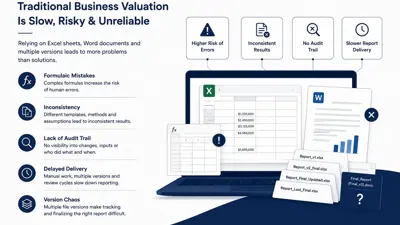
By 2026, Artificial Intelligence will enable faster, more accurate, and more structured valuation. AI-driven platforms like ValuPro AI enable finance professionals to transition from manual Excel and Word workflows to automated, audit-compliant valuation processes. ValuPro AI streamlines the entire valuation process by enabling document uploads, methodology selection, AI-powered valuation, risk assessments, report drafting, audit tracking, and the generation of final reports in DOCX or PDF format all within a single workflow.
Precise valuation matters because it directly influences investor confidence, deal pricing, regulatory compliance, shareholder decisions, and overall business strategy. AI enhances this process by cutting down on manual work, ensuring consistent assumptions, and boosting traceability.
2. Understanding AI in Financial Valuation
AI-driven valuation involves leveraging artificial intelligence to enhance the valuation process by automating data collection, conducting financial analysis, generating forecasts, identifying risks, and producing reports.
Key AI technologies applied in valuation include:
- Machine Learning ( ML): Assists in spotting patterns, categorizing industries, benchmarking historical valuations, and flagging atypical financial movements.
- Natural Language Processing ( NLP): Analyzes and interprets financial documents, presentations, reports, and management commentary.
- Predictive Analytics: Enables revenue forecasting, margin analysis, sensitivity testing, and scenario planning.
- Generative AI: Produces valuation narratives, executive summaries, explanations of assumptions, and draft reports.
In ValuPro AI, these technologies assist in analyzing financial documents, creating assumption ranges, calculating valuation results, identifying risk indicators, and producing professional valuation reports.
3. Traditional Valuation Methods vs AI-Driven Valuation
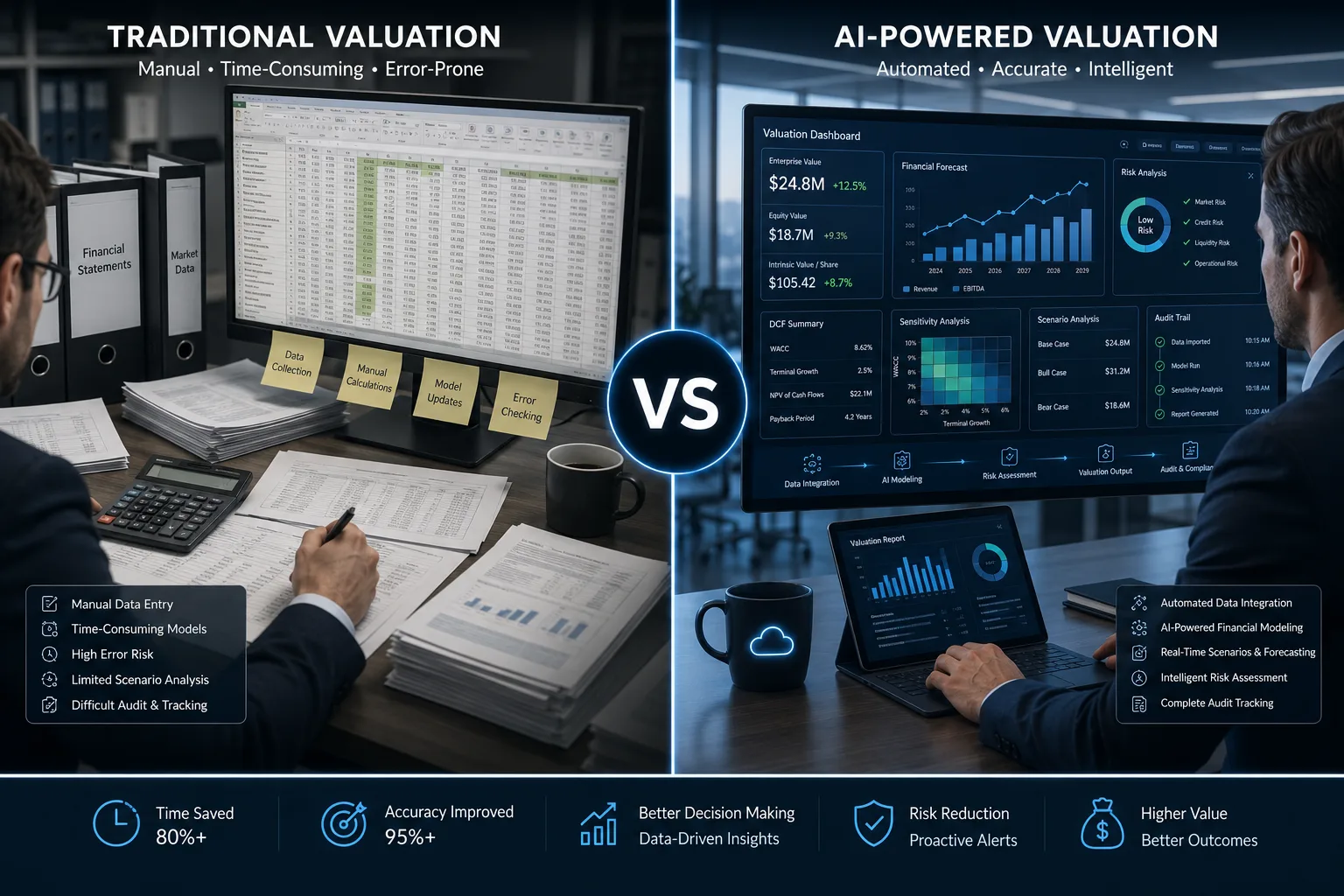
Traditional valuation methods are still indispensable. AI doesn’t replace them; it enhances how they are used.
Discounted Cash Flow (DCF)
- Discounted Cash Flow ( DCF DCF estimates a company’s value by calculating the present value of its expected future cash flows. It relies significantly on assumptions including revenue growth, margins, discount rate, terminal growth, and working capital.
- AI enhances DCF by assisting in generating assumptions, validating inputs, conducting sensitivity analysis, and clearly explaining valuation outcomes.
Comparable Company Analysis (CCA)
- Comparable Company Analysis ( CCA) estimates a company’s value by benchmarking it against similar publicly traded firms, using financial multiples like P/ E, EV/EBITDA, EV/ Revenue, and P/BV.
- AI assists in organizing peer data, identifying outliers, benchmarking multiples, and producing structured valuation commentary.
Precedent Transactions Analysis
- Precedent Transactions Analysis This approach estimates value by referencing previous mergers and acquisitions or investment deals. AI assists in analyzing transaction multiples, comparing deal relevance, and generating consistent explanations.
- Overall, AI boosts traditional valuation by increasing speed, consistency, validation, reporting, and auditability.
Necessary Valuation Method Details and Formulas
Below are the key valuation methods and formulas commonly used in AI-powered valuation platforms like ValuPro AI:
| Method | Purpose | Key Formula / Logic |
|---|---|---|
| DCF — FCFF | Values the entire firm using pre-debt cash flows. | FCFF = EBIT × (1 − Tax Rate) + Depreciation − Capex − ΔWorking Capital |
| DCF — FCFE | Values equity directly using cash flows available to shareholders. | FCFE = Net Income + Depreciation − Capex − ΔWorking Capital + Net Borrowings |
| Terminal Value | Captures value beyond the forecast period. | TV = FCFn × (1 + g) / (r − g) |
| Enterprise Value | Present value of FCFF and terminal value. | EV = Σ [FCFFt / (1 + WACC)t] + TV / (1 + WACC)n |
| Equity Value | Value attributable to shareholders. | Equity Value = Enterprise Value − Net Debt ± Adjustments |
| WACC | Discount rate for FCFF valuation. | WACC = Ke × (E/V) + Kd × (1 − Tax) × (D/V) |
| CAPM / Cost of Equity | Calculates expected return for equity investors. | Ke = Rf + β × ERP + Alpha |
| Precedent Transactions | Values a company using past transaction multiples. | Transaction Value = Transaction Multiple × Subject Company Metric |
| NAV | Values asset-heavy businesses. | NAV = Fair Value of Assets − Fair Value of Liabilities |
| Revenue Multiple | Useful for early-stage or pre-profit businesses. | Value = Revenue × Selected Revenue Multiple |
| Weighted Average Valuation | Combines multiple method outputs. | Final Value = Σ (Method Value × Method Weight) |
For listed company assignments, ValuPro AI can also support SEBI-related pricing calculations:
- VAmp = Σ(Pᵢ × Vᵢ) / Σ(Vᵢ)
Where Pᵢ is the closing price and Vᵢ is traded volume for each trading day.
- SEBI Floor Price = MAX(P1, P2, P3, P4)
Where P1 is negotiated price, P2 is acquirer’s 52-week purchase VWAP, P3 is highest price paid in 26 weeks, and P4 is VAmp_60TD on the highest-volume exchange.
- ICDR Issue Price = MAX(VAmp_26W, VAmp_2W)
AI improves these methods by validating inputs, generating assumption ranges, running sensitivity checks, identifying risk flags, and preparing clear valuation commentary for reports.
4. Key Ways AI is Transforming Financial Valuation
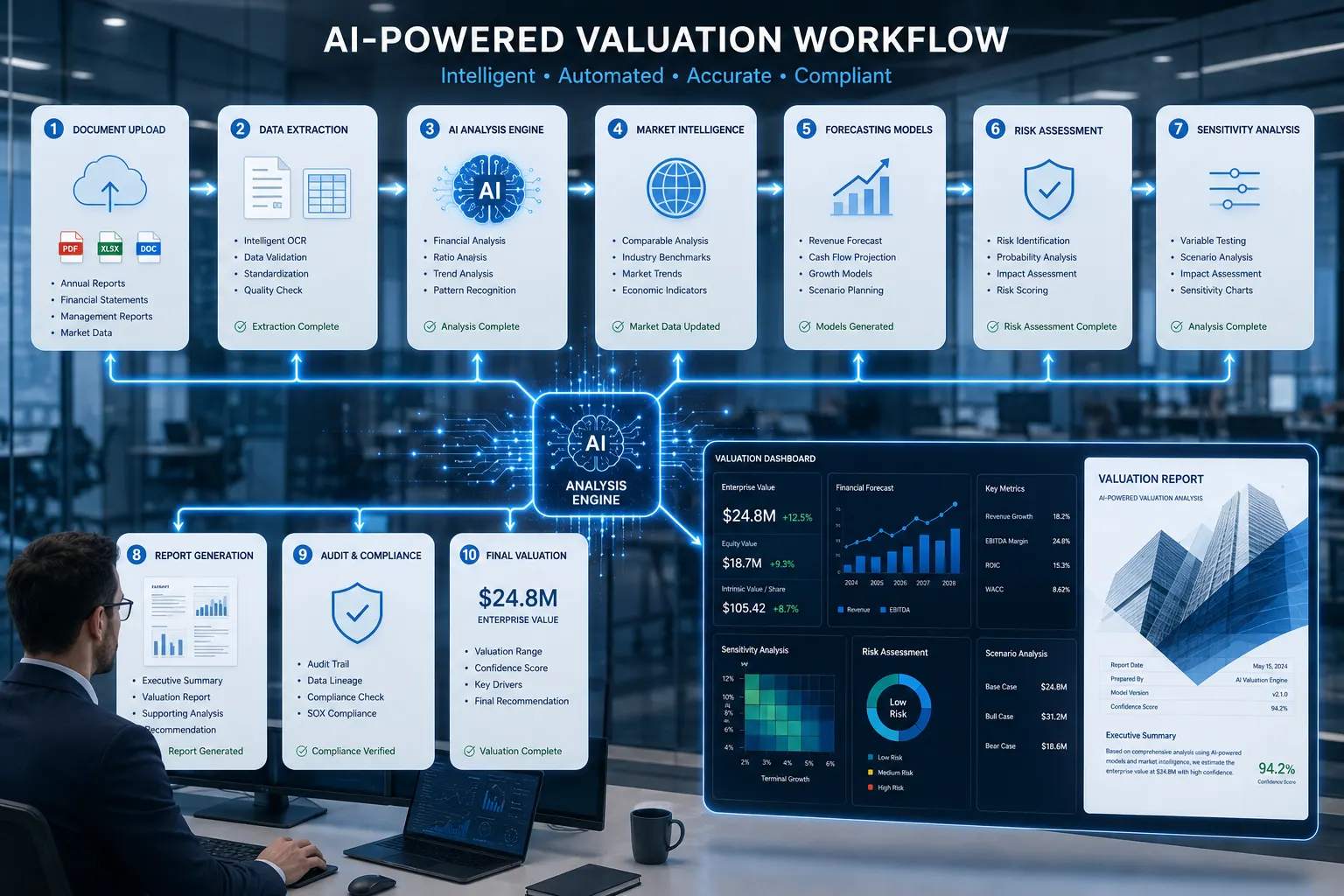
AI is reshaping valuation through several practical applications:
- Automated data processing: AI pulls and organizes financial data from Excel, CSV, PDF, DOCX, and PPTX files.
- Real-time market analysis: Pricing for listed companies can be supported via market data processing and SEBI-compliant VAmp calculations.
- Improved forecasting: AI proposes assumption ranges drawing from financial data, industry characteristics, and past valuation trends.
- Risk assessment: AI and rule-based checks flag problems like high debt, unusual growth patterns, negative working capital, or implausible terminal growth projections.
- Automated reporting: AI creates valuation narratives, executive summaries, sensitivity analyses, and preliminary report drafts.
ValuPro AI integrates these capabilities into a structured 8-step workflow, enabling teams to finish valuation assignments more quickly and with greater control.
5. Benefits of AI in Financial Valuation
AI offers significant benefits to finance professionals and valuation firms
- Faster turnaround: Preparing valuations can cut down from multiple analyst-days to a much quicker process.
- Improved accuracy: Automation of validation helps minimize spreadsheet errors and the risk of missing data.
- Consistency: Using standard workflows and templates enhances report quality.
- Improved decision-making: Sensitivity tables, risk indicators, and assumption ranges help enhance judgment.
- Lower cost: Automation cuts down on manual labor and boosts productivity.
- Scalability: Teams can handle more companies and assignments without needing to increase their workload proportionally.
6. Real-World Applications of AI in Valuation
AI-powered valuation supports various finance activities, including:
- Investment Banking: Building DCF models, conducting comparable company analyses, enhancing pitchbook preparation, and assessing transaction values.
- Private Equity and Venture Capital: Assessing potential companies, reviewing growth projections, and examining possible exit strategies.
- Corporate Finance: Assisting with internal valuation, fundraising, restructuring, and strategic planning.
- Mergers and Acquisitions: Evaluating potential targets, assessing deal multiples, identifying synergies, and determining valuation ranges.
- Equity Research and Portfolio Management: Refining valuation models, benchmarking against industry peers, and tracking shifts in market-driven valuations.
7. AI-Powered Financial Valuation Tools and Platforms
Professional AI valuation platform must feature - Secure document upload and parsing.
- Various valuation approaches including DCF, CCA, NAV, DDM, Revenue Multiple, and Precedent Transactions.
- Generation of assumptions guided by AI.
- Analysis of sensitivity and identification of risks.
- Access control based on user roles.
- Audit trails and version records.
- Automatic creation of reports in DOCX and PDF formats.
- Ensure data privacy and redact PII prior to AI processing.
ValuPro AI incorporates these features and enables a managed valuation process, from assignment setup to the production of the final report.
Core Capabilities That Make ValuPro AI a Complete Valuation Platform
The ValuPro AI documentation also emphasizes several key features that enhance the valuation process
- 8-step gated workflow: Users progress from creating an assignment to generating the final report in a series of controlled stages, with each subsequent step only becoming available after necessary validations are successfully completed.
- Smart Parser with confidence scoring: Financial line items are automatically mapped, and those with low confidence are flagged for analyst review.
- Sector classification and sector defaults: AI determines the company’s sector and applies sector-specific defaults to aid in generating assumptions.
- RAG-based knowledge reuse: Previously conducted valuations can serve as contextual references to enhance assumption suggestions and benchmark outcomes.
- Reverse valuation: Users input a desired equity value, and the AI calculates the necessary assumptions to achieve it, within defined limits.
- Versioning and audit logs: All key actionsincluding valuation runs, financial edits, and report changesare recorded to ensure audit compliance.
- Privacy by design: Personally identifiable information, including PAN, CIN, GSTIN, Aadhaar, bank details, and company name, is removed prior to external AI processing.
- Partner review and final locking: AI-generated narratives and risk flags are reviewed prior to final approval, and the final report is secured once generated.
These features make ValuPro AI more than a valuation calculator - it acts as a complete valuation workflow, governance, and reporting platform.
8. Challenges and Limitations
AI-based valuation also comes with constraints that require careful handling:
- Data quality: Inaccurate or insufficient financial data can impact the accuracy of valuation outcomes.
- Compliance: Adherence to regulatory requirements, including SEBI rules, ICAI standards, and data privacy laws, is mandatory.
- Explainability: Finance professionals need to comprehend how assumptions and outputs are derived.
- Cybersecurity: Encryption, access restrictions, and removal of personally identifiable information are essential to safeguard sensitive financial data.
- Human oversight: AI must assist expert judgment, not substitute for it.
ValuPro AI tackles these concerns using validation rules, audit logs, role-based access, PII redaction, risk flags, and Partner review prior to finalization.
9. Future Trends in AI-Driven Financial Valuation

What lies ahead for AI in valuation includes
- Real-time valuation models that adapt continuously using market and financial data.
- AI that provides clear explanations of its assumptions, calculations, and decision-making processes.
- ESG integration: incorporating sustainability and governance considerations into valuation.
- Use of generative AI in financial analysis to produce more transparent reports and deeper insights.
- Autonomous financial modelling: AI constructs and maintains models with little to no human intervention.
Nevertheless, human expertise will continue to be crucial for judgment, compliance, and final approval.
10. Best Practices for Businesses and Finance Professionals
To leverage AI effectively in valuation, businesses should Integrate AI automation with human insight.
- Choose tools designed expressly for financial valuation.
- Ensure all data is verified prior to executing valuation models.
- Evaluate the assumptions and narratives produced by AI.
- Keep audit logs and track version history.
- Adhere to regulatory, ethical, and data privacy standards.
- Have qualified professionals review and approve the final reports.
AI performs most effectively when it empowers professionals by delivering speed, structure, and insightwhile ensuring human judgment remains central.
11. Conclusion
AI is reshaping financial valuation by accelerating the process, enhancing clarity, ensuring greater consistency, and improving audit readiness. While traditional valuation methods such as DCF, CCA, NAV, and Precedent Transactions continue to hold significance, AI enhances the way these methods are carried out, assessed, and presented.
Tools such as ValuPro AI demonstrate how valuation can transition from manual spreadsheets and scattered documents to a streamlined, AI-driven workflow. For finance professionals, the future doesn’t mean replacing human expertise with AI it’s about leveraging AI to enhance efficiency, sharpen decision-making, and achieve stronger valuation results.