Why RBI’s Latest Move is a Game-Changer for Indian MSMEs
Naapbooks Insights • Indian MSMEs • 9 min read
Micro, Small, and Medium Enterprises (MSMEs) have long been hailed as the backbone of the Indian economy. Yet, ask any small business owner, and they will tell you that securing hassle-free bank credit has often felt like running an obstacle course.
In a massive move to ease credit flow, the Reserve Bank of India (RBI) rolled out the Lending to MSME Sector (Amendment) Directions, 2026.This update fundamentally reshapes how banks evaluate and fund small enterprises.
Here is everything you need to know about this landmark policy shift and what it means for your business.
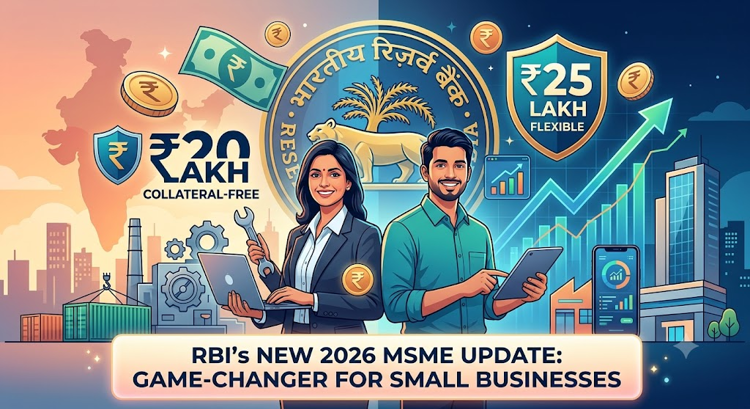
1. Collateral-Free Loan Limits Doubled to ₹20 Lakh
The headline update of the 2026 amendment is a massive relief for Micro and Small Enterprises (MSEs).
- The Old Rule: Previously, banks were restricted from demanding collateral security only for loans up to ₹10 lakh.
- The New Rule: The RBI has officially doubled the collateral-free threshold to ₹20 lakh. Banks can no longer mandate collateral for loans up to this amount extended to MSE units, including those funded under the Prime Minister’s Employment Generation Programme (PMEGP).
Why this matters: For early-stage startups and small-scale manufacturers who lack hard assets like property to pledge, this opens direct access to formal institutional credit without putting family assets at risk.
2. Higher Flexibility: Collateral Exemption up to ₹25 Lakh
The RBI isn't stopping at ₹20 lakh. For businesses with a solid financial footing, the central bank has granted commercial lenders more autonomy.
- Banks are now permitted to dispense with collateral requirements for loans up to ₹25 lakh, based on their internal board-approved policies and the borrower's positive track record.
If your business boasts clean credit, regular cash flows, and transparent tax filings, you stand a strong chance of securing a larger capital runway without backing it with collateral.
3. Voluntary Pledges of Gold and Silver Permitted
In a highly pragmatic move, the RBI clarified that if a borrower voluntarily decides to pledge gold or silver ornaments to secure a loan within the collateral-free limit, it will not be treated as a regulatory violation by the bank.
This ensures that entrepreneurs can leverage personal liquidity channels quickly during seasonal or urgent business crunches.
4. Slashing Red Tape: Deletion of Paragraph 6.5
Beyond the numbers, the RBI has aimed its scissors at bureaucratic friction. The 2026 amendment has completely deleted Paragraph 6.5 from the Master Directions.
By removing these rigid, outdated regulatory and mandatory compliance reporting frameworks for lenders, banks can now pivot toward more agile, digital-first onboarding systems.
This simplifies the application pipeline, accelerating the time it takes from submitting a digital loan application to getting the funds disbursed into your account.
At a Glance: What Has Changed?
| Feature | Previous Framework | New 2026 Framework |
|---|---|---|
| Mandatory Collateral-Free Limit | Up to ₹10 Lakh | Up to ₹20 Lakh |
| PMEGP Loans Collateral Exemption | Up to ₹10 Lakh | Up to ₹20 Lakh |
| Discretionary Collateral-Free Limit | Limited / Bank-specific | Up to ₹25 Lakh (Based on track record) |
| Voluntary Gold/Silver Pledge | Ambiguous | Explicitly Permitted |
The Big Picture: A Paradigm Shift to Cash-Flow Lending
Coupled with India's expanding digital infrastructure like the Udyam Assist Platform (UAP) for informal enterprises and GST-linked analytics, the RBI is signaling a fundamental mindset shift.
Lenders are moving away from the traditional, rigid "balance-sheet and collateral" model toward a cash-flow-based lending approach.
If you are an MSME owner looking to scale up, modernise your machinery, or manage working capital cycles, there has never been a better time to approach formal banking channels.
Make sure your Udyam Registration is updated, keep your GST filings tidy, and take full advantage of this credit-friendly landscape.