AI Around Us: The Invisible Technology Changing Everyday Life
Naapbooks Insights • AI Around Us • 9 min read
- What Is Artificial Intelligence?
- Why AI Is Everywhere Now?
- How AI Powers Your Daily Digital Life
- Where Does AI Show Up in Your Smartphone and Smart Devices?
- How Is AI Used in Healthcare and Wellness?
- How Is AI Changing Education and Learning?
- How Does AI Protect and Manage Your Money?
- How Does AI Actually Make a Decision?
- Pros and Cons of AI in Everyday Life
- Conclusion
Quick answer: You already use artificial intelligence dozens of times a day unlocking your phone with your face, getting a Netflix suggestion, or receiving a fraud alert from your bank. Most of this AI works quietly in the background, which is why it's often called "invisible AI."
You probably picture AI as a humanoid robot or a sci-fi supercomputer. The truth is much less dramatic and much closer to home. AI shows up in the small, ordinary moments of your day: unlocking your phone, typing a text, checking your bank balance, or asking a smart speaker for the weather.
Most of the time, you don't even notice it's there.
This guide walks through exactly where AI shows up in daily life, what it's actually doing behind the scenes, and where it's headed next.
What Is Artificial Intelligence?
Definition: Artificial intelligence (AI) is technology that lets computers perform tasks that normally require human thinking recognizing patterns, making decisions, understanding language, and learning from experience.
AI isn't one single thing. It's an umbrella term covering several distinct technologies you interact with every day:
| Type of AI | What It Does | Where You See It |
|---|---|---|
| Machine Learning (ML) | Improves by analyzing data over time | Product recommendations, spam filters |
| Natural Language Processing (NLP) | Understands human speech and text | Siri, Alexa, ChatGPT, autocorrect |
| Computer Vision | Interprets and recognizes images | Face ID, photo tagging, self-driving cars |
| Predictive Analytics | Forecasts outcomes from past behavior | Traffic apps, credit scoring, fraud alerts |
Key takeaway: AI doesn't need to look intelligent to be intelligent. Most of it works silently inside apps you already use every day.
Why Is AI Everywhere Now?
A decade ago, AI mostly lived in research labs and a handful of big technology companies. Today, it's in your pocket, your living room, your car, and even your doctor's office.
Three shifts made this possible:
- More data. Billions of people generate data every day, giving AI systems more to learn from.
- Cheaper computing power. Processing that once needed a data center now runs on a smartphone chip.
- Smarter algorithms. Modern models learn faster and more accurately than earlier generations.
The result is what experts call "invisible AI" technology so deeply embedded in everyday products that most people never stop to think of it as AI at all.
How AI Powers Your Daily Digital Life
How Does AI Work in Search Engines and Recommendations?
Every time you type a search into Google, AI interprets what you actually mean, factors in context, and ranks millions of pages in a fraction of a second.
Streaming platforms like YouTube, Spotify, and Netflix use similar systems: they study your viewing and listening habits, then suggest content you're statistically likely to enjoy.
How Does AI Shape Your Social Media Feed?
Your feed isn't random. It's built by algorithms trained to predict which posts, videos, or ads will keep you scrolling. Every like, comment, share, and even how long you pause on a post feeds data back into the system.
How Does AI Filter Your Email?
Spam filters use AI to catch unwanted or malicious emails before they reach your inbox. Features like Gmail's Smart Reply go a step further, scanning your messages and drafting quick response suggestions.
How Do Voice Assistants and Chatbots Understand You?
Siri, Alexa, Google Assistant, and AI chatbots like ChatGPT rely on Natural Language Processing (NLP) technology that lets a machine understand a spoken or typed question and generate a useful response.
Where Does AI Show Up in Your Smartphone and Smart Devices?
- Facial recognition and biometric security: Face ID and similar systems use neural networks to map facial features and confirm your identity securely.
- Predictive text and autocorrect: Your keyboard learns your writing habits, predicts your next word, and quietly fixes typos as you go.
- Smart camera enhancements: Your phone's camera uses AI to detect faces, recognize scenes, adjust settings automatically, and improve low-light shots.
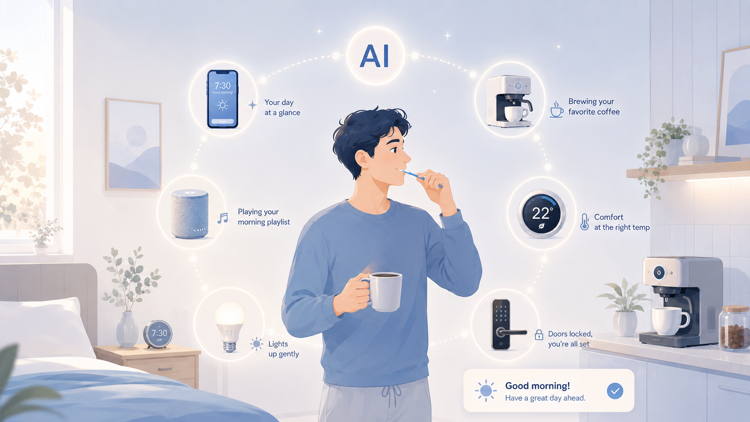
- Smart home automation: Thermostats, speakers, and security systems learn your routines and automate everyday household tasks like lowering the temperature before you get home.
How Does AI Change the Way You Shop Online?
- Personalized product recommendations: Platforms like Amazon study your shopping history to surface products you're more likely to buy.
- Dynamic pricing: Prices shift automatically based on demand, competitor pricing, and market conditions.
- Virtual shopping assistants: AI chat tools help you find products, check stock, and complete checkout without waiting for a human agent.
- Supply chain optimization: Retailers use AI to forecast demand, manage inventory, and speed up delivery.
How Does AI Help You Get Around Faster?
- GPS route optimization: Google Maps and Apple Maps analyze live traffic data to suggest the fastest route in real time.
- Ride-sharing matching: Apps like Uber use AI to pair riders with drivers, predict demand spikes, and adjust pricing accordingly.
- Traffic prediction systems: Many cities now use AI-powered traffic management to ease congestion and improve flow.
- Self-driving technology: Autonomous vehicles combine computer vision, sensors, and machine learning to read the road and react safely.
How Is AI Used in Healthcare and Wellness?
- Fitness and health tracking: Wearables like Apple Watch and Fitbit use AI to monitor activity, sleep quality, and heart health trends.
- AI-assisted diagnostics: Medical AI can analyze scans and images to help doctors spot potential health issues earlier.
- Personalized health recommendations: Wellness apps use your personal data to tailor advice on fitness, nutrition, and general wellbeing.
- Remote patient support: AI-powered telehealth tools help with initial symptom checks and post-visit follow-ups.
Expert note: AI-assisted diagnostics support doctors they don't replace clinical judgment. Always treat AI health suggestions as a starting point for a conversation with a qualified professional, not a diagnosis.
How Is AI Changing Education and Learning?
- Personalized learning platforms: Tools like Khan Academy and Duolingo adjust lesson difficulty based on how each learner is progressing.
- Intelligent tutoring systems: AI tutors can answer questions, explain concepts, and track performance over time.
- Automated assessments: AI can grade tests and generate performance reports for both students and teachers.
- Language learning apps: Speech recognition helps learners fine-tune pronunciation and build language skills faster.
How Does AI Protect and Manage Your Money?
- Fraud detection: Banks use machine learning to flag suspicious transactions in real time and prevent fraud before it happens.
- Digital banking assistants: AI chat tools help customers check balances, transfer funds, and manage accounts without a call center.
- Credit scoring and risk analysis: Modern lending systems weigh a broader range of data points to make more informed lending decisions.
- Personalized financial insights: Budgeting apps analyze your spending patterns and suggest ways to improve your financial health.
How Does AI Actually Make a Decision?
It helps to understand the basic process behind most everyday AI, whether it's a fraud alert or a shopping recommendation:
- Data collection. The system gathers relevant data your past purchases, your typing patterns, your location, or your spending history.
- Pattern analysis. The AI model looks for patterns or similarities to data it has seen before.
- Prediction or decision. Based on those patterns, it predicts an outcome what you'll want to buy, whether a transaction looks suspicious, or which route is fastest.
- Action or suggestion. The system acts on that prediction: it shows you a recommendation, blocks a transaction, or reroutes your GPS.
- Feedback loop. Your response clicking, ignoring, confirming, or reporting an error feeds back into the system, helping it refine future predictions.
This loop is why AI tools seem to "get to know you" the more you use them.
Pros and Cons of AI in Everyday Life
| Pros | Cons |
|---|---|
| Faster, more convenient services | Heavy reliance on personal data |
| Reduced manual effort and errors | Risk of algorithmic bias |
| Personalized recommendations | Data security and breach risks |
| Early fraud and health-issue detection | Limited transparency in how decisions are made |
The Real Benefits of AI in Everyday Life
- Convenience: Faster services with far less manual effort.
- Efficiency: Smoother business operations and better customer experiences.
- Better decisions: Personalized recommendations and insights based on real data.
- Improved safety: Earlier detection of fraud, health risks, and security threats.
Challenges and Ethical Considerations of AI
AI's benefits come with real trade-offs. Being aware of them helps you use AI tools more responsibly.
- Privacy concerns: AI systems typically rely on large volumes of personal data to function well.
- Data security risks: Centralized data storage becomes an attractive target for cyberattacks.
- Algorithmic bias: AI can inherit and amplify biases already present in the historical data it was trained on.
- Transparency gaps: It's often difficult to understand exactly how an AI system arrived at a particular decision.
Common mistake to avoid: Assuming an AI-generated recommendation, price, or credit decision is automatically neutral or unbiased. It's shaped by the data and rules behind it, so it's worth a second look especially for high-stakes decisions like loans or healthcare.
The Future of AI in Daily Life
- Smarter homes and cities: Future AI systems are expected to better understand human behavior and automate more everyday tasks.
- Human-AI collaboration: AI will increasingly work alongside professionals not replace them to improve productivity and decision-making.
Emerging AI Innovations to Watch
- Multimodal AI systems that understand text, images, audio, and video together.
- Edge AI AI processing that happens directly on your device, instead of in the cloud.
- Agentic AI AI systems capable of carrying out multi-step tasks with less human input.
What Can Consumers Expect Next?
- More personalized digital experiences
- Better understanding of natural human language
- Deeper integration across your everyday devices
- Stronger regulation around privacy and transparency
Note: The pace and specifics of future AI regulation vary significantly by country and are still evolving. Treat forward-looking predictions in this section as informed general trends, not guaranteed outcomes.
Key Takeaways
- AI is already embedded in the everyday tools you use phones, shopping apps, banking, healthcare, and education.
- Most AI works invisibly, which is why it's easy to underestimate how often you rely on it.
- The core benefits are convenience, efficiency, personalization, and improved safety.
- The core risks are privacy exposure, algorithmic bias, and limited transparency.
- The future points toward more collaboration between humans and AI systems, alongside stronger privacy regulation.
Checklist: Spotting AI in Your Daily Routine
- Unlocked your phone with your face or fingerprint today?
- Got a personalized shopping or streaming recommendation?
- Used GPS navigation or a ride-sharing app?
- Received a fraud alert or used a banking app?
- Asked a voice assistant a question?
If you checked even one box, you used AI today.
Conclusion
AI is no longer a futuristic concept it's already shaping how we search, shop, travel, learn, manage our health, and handle our money. Most of it happens quietly, without asking for your attention.
Understanding where AI shows up and where its risks lie helps you use it more intentionally, whether you're an individual managing your own digital life or a business deciding how to adopt these tools responsibly.