How Blockchain Is Changing Financial Services in 2026
Naapbooks Insights • Blockchain Services • 9 min read
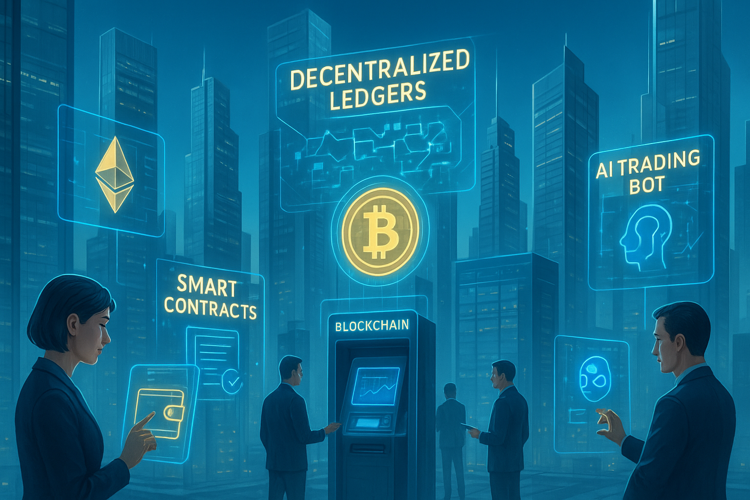
Banks spent the better part of a decade treating blockchain as a science project. That phase is over. In 2026, distributed ledger technology sits inside live payment rails, tokenized bond desks, and compliance systems at major financial institutions. This guide breaks down what's actually changing, backed by current data, and where the technology still falls short.
What Is Blockchain in Simple Terms?
A blockchain is a shared, tamper-resistant digital record of transactions maintained across many computers instead of one central server. Each entry links to the one before it, so altering past records would require rewriting the entire chain, which is computationally impractical on a well-run network. In finance, this shared record replaces the reconciliation work banks normally do manually.
Three properties matter most for banking: shared truth (every party sees the same record, cutting reconciliation costs), programmability (smart contracts automate settlement), and selective transparency (public chains like Ethereum are open to anyone, while permissioned chains restrict access to vetted institutions, which is why most banks use the latter). Crypto headlines often blur "blockchain" with speculative trading, but bank-grade systems function more like secure, shared databases.
Why Is 2026 a Turning Point for Blockchain in Finance?
2026 stands apart from earlier blockchain cycles because the money now moving on-chain represents real institutional balance sheets, not retail speculation. Tokenized assets have crossed from pilot to production, and regulators in major economies have replaced ambiguity with binding rules, even if those rules differ sharply by jurisdiction.
On-chain value for tokenized real-world assets, excluding stablecoins, reached roughly $30 billion by mid-2026, up from about $12 billion a year earlier, per data tracked by rwa.xyz and reported by Finextra and The Block. Tokenized U.S. Treasuries alone account for over $10 billion, led by BlackRock's BUIDL and Franklin Templeton's BENJI. The World Economic Forum's January 2026 digital assets outlook identifies tokenization as one of the year's defining trends, with momentum increasingly driven by traditional institutions rather than crypto-native firms, and regulatory clarity advancing fastest in Singapore, the UAE, Hong Kong, the EU, and the US.
How Is Blockchain Changing Financial Services?
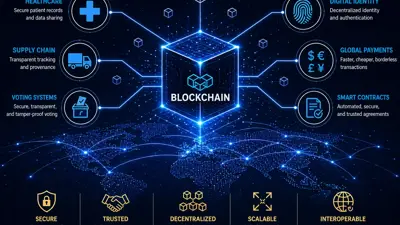
Blockchain's clearest impact is in six areas: cross-border payments, asset tokenization, trade finance, lending, KYC compliance, and insurance claims. Payments and tokenization show the strongest institutional adoption; the others are progressing more slowly due to standardization and trust hurdles.
Cross-Border Payments
Wires still take one to three business days and cost $25 to $50 in intermediary fees. Blockchain rails settle many transfers in minutes, at a fraction of the cost, by cutting the correspondent-bank chain a traditional wire depends on. This remains the most proven use case in banking.
Asset Tokenization
U.S. securities now settle on a T+1 cycle, but tokenized securities can settle near-instantly since ownership transfer and payment happen in one transaction. Tokenization also enables fractional ownership of real estate or private credit funds. The catch: a 2026 Forbes analysis found tens of billions in tokenized assets see almost no trading after issuance. Dividing an asset digitally doesn't automatically create buyers for it.
Trade Finance
Letters of credit historically took days or weeks across multiple parties. Blockchain trade platforms replace paper trails with shared digital records everyone can verify at once, cutting delays and disputes.
Lending, KYC, and Insurance
Smart contracts automate collateral monitoring and liquidation. Shared, permissioned identity verification could let a customer complete KYC once and reuse it everywhere, though this needs industry-wide standards. Insurers are testing parametric policies that pay out automatically once a condition, like a flight delay, is met.
Benefits of Blockchain for Financial Institutions
Blockchain's main benefits for banks are lower transaction costs, faster settlement, stronger fraud resistance, and improved liquidity for hard-to-trade assets. These gains are strongest in payments and tokenization, where deployments are already live rather than theoretical.
| Area | Benefit | Trade-off to Watch |
|---|---|---|
| Cross-border payments | Settlement in minutes, lower fees | Liquidity still needed on both ends of the corridor |
| Asset tokenization | Fractional ownership, near-instant settlement | Secondary market liquidity remains thin for many tokens |
| Trade finance | Faster document verification, less fraud | Requires all trading partners on the same platform |
| Lending | Automated collateral management | Smart contract or oracle failures carry real financial risk |
| KYC and compliance | Lower onboarding cost, less redundancy | Needs industry-wide shared standards |
Quick facts: tokenized RWAs reached ~$30B on-chain by mid-2026 (up from ~$12B); the DTCC (custodian of $100T+ in securities) is piloting blockchain settlement; U.S. equities settle on a T+1 cycle; traditional cross-border wires cost $25 to $50 versus a fraction of that on-chain.
Challenges of Blockchain in Finance
Blockchain in finance still faces five unresolved challenges: limited transaction throughput on public networks, poor interoperability between chains, thin liquidity in many tokenized markets, regulatory fragmentation across borders, and a shortage of talent who understand both blockchain and banking compliance.
- Scalability: public blockchains process far fewer transactions per second than networks like Visa; most banks work around this with private chains or layer-2 networks.
- Interoperability: different blockchain networks generally can't communicate natively, and cross-chain bridges remain a frequent exploit target.
- Liquidity: tokenizing an asset doesn't guarantee a market for it, as noted above.
- Regulatory fragmentation: MiCA and the GENIUS Act provide clarity within their own borders, but cross-border banks must still reconcile differing custody and securities rules.
- Talent: legacy core banking systems weren't built to interface with distributed ledgers, and specialists who understand both domains remain scarce.
Best Practices for Blockchain Adoption
Institutions that succeed with blockchain typically start with one well-defined problem rather than an enterprise-wide overhaul, and build regulatory engagement in from day one.
- Pick one high-friction process, such as reconciliation or settlement, rather than a platform-wide migration.
- Run a scoped pilot with clear success metrics before committing production volume.
- Engage regulators early, especially for anything touching securities or customer funds.
- Choose permissioned or hybrid architecture when privacy and compliance are non-negotiable.
- Budget for talent and integration work separately from the platform cost itself.
Common Mistakes to Avoid
- Treating tokenization as a liquidity strategy by itself, without a distribution or market-making plan.
- Underestimating the cost of integrating blockchain with legacy core banking infrastructure.
- Assuming one jurisdiction's approval, like MiCA, automatically satisfies another market's rules.
- Confusing public crypto market volatility with the risk profile of permissioned, institutional deployments.
Real-World Examples
BlackRock, Franklin Templeton, and J.P. Morgan already run live blockchain products in production, not pilots, and the DTCC's tokenization pilot signals that core market infrastructure, not just individual banks, is moving on-chain.
BlackRock's BUIDL and Franklin Templeton's BENJI together hold a large share of tokenized Treasury value in 2026, and J.P. Morgan has issued tokenized asset-backed securities through its own blockchain unit. Most notably, the DTCC, custodian of over $100 trillion in securities, received SEC clearance for a multi-year pilot tokenizing DTC-custodied assets, rolling out in the second half of 2026.
Future Trends in Blockchain and Finance
Looking past 2026, expect continued growth in institutional tokenization, closer integration between blockchain and AI-driven compliance tools, and a widening gap between countries actively piloting central bank digital currencies and those, like the US, that have paused theirs by law.
The US is legally barred from issuing a digital dollar until at least 2030, following legislation enacted in July 2026. The ECB, by contrast, selected 36 payment providers in July 2026 for a digital euro pilot, though full rollout isn't expected before 2029. China's e-CNY, India's e-Rupee, and pilots in Brazil and Australia continue advancing, while private stablecoins remain the dominant form of blockchain-based money in global payments today, a trend McKinsey's 2026 banking research also flags as reshaping the industry.
Author Perspective
The pattern that stands out in 2026 is a narrowing of ambition paired with a widening of adoption. Fewer institutions talk about blockchain reinventing money; more are quietly using it to fix one specific, expensive problem, like slow settlement or illiquid collateral. Boring, well-scoped deployments tend to survive longer than grand reinventions, a conclusion Deloitte and WEF's own joint research on financial infrastructure reached years ago: distributed ledger technology brings real efficiency but works best paired with cooperation between incumbents, innovators, and regulators, not as a cure-all.
Frequently Asked Questions
What is blockchain in simple terms?
A shared, tamper-resistant digital record maintained across many computers instead of one central server. Every authorized participant sees the same record, which removes much of the manual reconciliation traditional databases require, while cryptography makes past entries very hard to alter undetected.
Is blockchain the same as cryptocurrency?
No, cryptocurrency is one application built on blockchain technology. Banks mainly use blockchain for payments, settlement, and record-keeping, a different use case from the retail crypto trading that dominates headlines.
How is blockchain used in banking today?
Mainly for cross-border payments, tokenized securities settlement, trade finance documentation, and identity verification. Payments and tokenization have the deepest institutional adoption; KYC-sharing and lending are still scaling since they need multiple institutions to agree on shared standards.
Are central bank digital currencies coming soon?
It depends heavily on the country. The US is barred from issuing a digital dollar until at least 2030; the EU is piloting a digital euro in 2027 with a possible 2029 launch. China, India, Brazil, and Australia continue their own pilots on separate timelines.
What is asset tokenization?
Converting ownership rights in a real asset into a digital token that can be transferred on a blockchain. Common examples include tokenized government bonds, private credit funds, and fractional real estate, though not all attract meaningful secondary trading once issued.
Is tokenized real estate actually liquid?
Not always, and this is one of the more overstated claims in blockchain marketing. Tokenizing a property makes fractional ownership technically possible, but a large share of tokenized assets see minimal trading after launch, so liquidity depends on real buyer demand.
What is MiCA?
The EU's Markets in Crypto-Assets regulation governing crypto-asset issuers and service providers. It sets binding rules for stablecoins and crypto service providers in the EU and already shapes which stablecoins can legally serve European customers.
What is the GENIUS Act?
US federal legislation that created a regulatory framework for payment stablecoins. It gives American banks clearer legal footing to work with dollar-backed digital tokens, closing a gap that previously left issuers in regulatory limbo.
Does blockchain actually reduce banking costs?
In specific use cases, yes, mainly by removing intermediaries and manual reconciliation. Cross-border payments show the clearest documented savings; broad claims of blanket cost reduction across all banking operations deserve some skepticism without institution-specific data.
What are the biggest risks of blockchain in finance?
Smart contract bugs, cross-chain bridge exploits, regulatory fragmentation, and thin liquidity in tokenized markets. Institutions managing these risks favor permissioned networks, independent security audits, and scoped pilots over broad, fast rollouts.
Will blockchain replace traditional banking?
Unlikely in the near term. Most deployments integrate blockchain into existing banking infrastructure to solve specific problems rather than replacing banks outright.
Key Takeaways
- Tokenized real-world assets reached roughly $30 billion on-chain by mid-2026, up from about $12 billion a year prior.
- The DTCC, custodian of over $100 trillion in securities, is piloting blockchain-based settlement, a strong signal of institutional confidence.
- CBDC progress is uneven: the US is barred from issuing a digital dollar until 2030, while the EU is piloting a digital euro with a possible 2029 launch.
- Cross-border payments remain the clearest, most proven blockchain use case in banking today.
- Tokenization creates fractional ownership but doesn't guarantee liquidity; a large share of tokenized assets see minimal trading.
- MiCA in the EU and the GENIUS Act in the US have given institutions clearer, if different, regulatory footing.
Conclusion
Blockchain in 2026 isn't a bet on one dramatic outcome. It's a set of specific, provable improvements in payments, settlement, and asset servicing, alongside real unresolved questions about liquidity and cross-border regulation. Institutions treating it as a targeted tool for well-defined problems are seeing results.
Considering where blockchain fits into your institution's roadmap? Start with the use case that has the clearest ROI for your business, whether that's cross-border settlement, trade finance, or compliance automation, rather than trying to adopt the technology all at once.