Should You Build a Custom ERP? The Honest Decision Guide
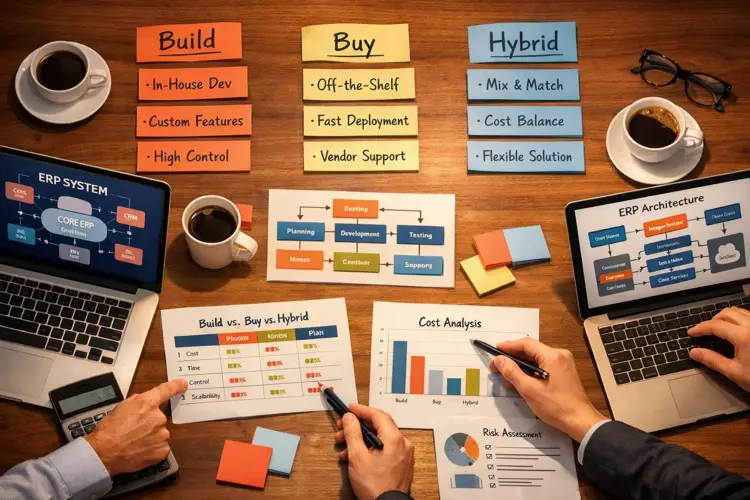
You're sitting in yet another conference room, staring at spreadsheets that compare SAP against Oracle against NetSuite. Or maybe you're looking at a proposal from your engineering team to build something custom. Either way, you know this decision will define how your company operates for the next five years.
And honestly? It's way more complicated than it should be.
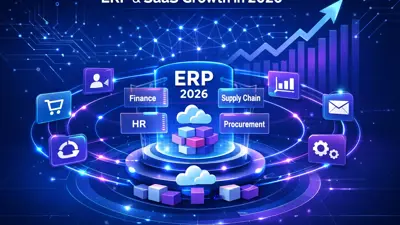
The build versus buy ERP question used to be simpler. Back in 2016, you either bought a big enterprise suite or you didn't. But in 2026, the landscape has shifted. We now have composable ERP systems, API ecosystems, vertical SaaS tools, and AI layers that change everything. The real question isn't "build or buy" anymore. It's "what should we build, what should we buy, and how do we make them work together?"
This guide walks you through the honest reality of this decision. No vendor pitches. No consultant speak. Just the framework you need to make a choice you can defend three years from now.
Why This Decision Feels Impossible Right Now
ERP Isn't Just Software Anymore
Here's what changed. ERP used to be a software purchase. You bought licenses, hired consultants, went through a painful implementation, and then lived with your choice for a decade.
Now ERP is an operating model. It's how data flows across your business. It's how teams make decisions. It's the foundation for every automation you'll build in the next five years.
When you choose to build or buy, you're not picking features. You're choosing how your entire organization will evolve.
The New Trade-Off Nobody Talks About
The old debate was vendor lock-in versus customization. Pretty straightforward.
The new trade-off is vendor dependency versus internal complexity. Both paths create dependencies. The question is which type of dependency you're better equipped to manage.
Buying from vendors means you depend on their roadmap, their pricing changes, and their support quality. Building custom means you depend on retaining specific engineers, maintaining legacy code, and funding ongoing development when business priorities shift.
Neither option gives you total control. Both require ongoing investment. Most companies fail to model this honestly.
The 10 Dimensions That Actually Matter
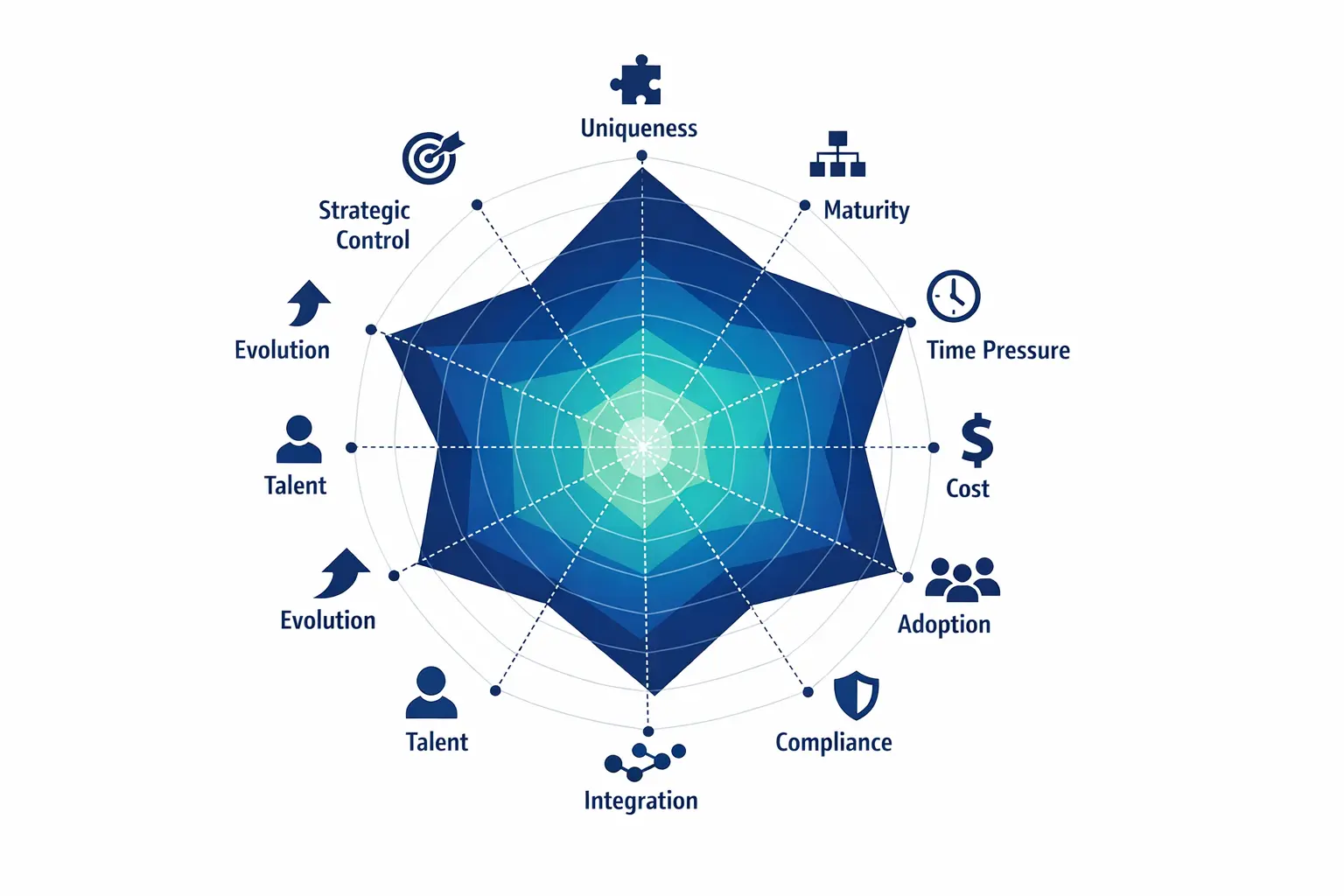
Here's the decision framework that works in practice. Score your situation on each dimension before you commit to a path.
1. Process Uniqueness
The core question: Are your business processes industry standard or truly unique?
Every company thinks their processes are special. Most are wrong. You need to be brutally honest here.
Build signals:
- Your process is your product (logistics companies, financial platforms, marketplaces)
- Industry analysts don't understand how your business works
- Competitors can't replicate what you do operationally
Buy signals:
- You do GL, AP, AR, payroll, basic HR like everyone else
- Your differentiation is in product, sales, or customer service (not operations)
- You use standard terms like "quote to cash" without modifications
Red flag: Building custom general ledger, accounts payable, or payroll systems. These are solved problems. Don't rebuild them unless you have an extraordinary reason.
2. Organizational Maturity
The core question: Can your organization actually maintain what it builds?
Technical capability is only half the equation. The other half is organizational discipline.
Build signals:
- You have stable, documented processes
- Teams can write clear requirements and stick to them
- You have a track record of maintaining complex systems
- Knowledge is distributed, not concentrated in a few heroes
Buy signals:
- Processes change constantly based on whoever is loudest
- Requirements emerge during implementation, not before
- Systems become black boxes when key people leave
- You've struggled to maintain past custom systems
Be honest about your organization's track record. Past behavior predicts future capability better than aspirational statements.
3. Time to Value Pressure
The core question: How fast do you need this working?
Buy signals:
- You need material improvement in 6 months
- Revenue or operational goals depend on rapid deployment
- Current systems are actively breaking and causing problems
- Opportunity cost of delay is measurable and high
Build signals:
- You can invest 2+ years for the right foundation
- Current systems are functional, just limiting
- Leadership is committed to long term investment
- You're optimizing for 5 year outcomes, not 1 year wins
Time pressure often forces buy decisions. That's not wrong. Just be clear eyed that you're optimizing for speed over fit.
4. Total Cost of Ownership
The core question: What does this really cost over 5 years?
This is where most analysis falls apart. Teams compare year one costs instead of modeling the full curve.
Build costs people forget:
- Developer salaries (including attrition and backfill)
- QA and testing infrastructure
- DevOps, security, compliance, and infrastructure
- Ongoing feature development
- Technical debt remediation
- Documentation and training
- Support and maintenance
Buy costs people forget:
- License escalation (especially when you grow)
- Implementation and customization
- System integration with other tools
- Consultant fees (which never really end)
- Upgrade costs every few years
- Training every time the vendor changes the UI
- Data migration if you ever want to leave
The real insight: Both paths get expensive in years 3 through 5. Build costs stay steadier. Buy costs often escalate faster than expected.
Model this realistically. Include the costs that make you uncomfortable.
5. Change Management and Adoption Risk
The core question: Which path will your users actually embrace?
Users resist change whether you build or buy. The difference is what kind of resistance you face.
Buy challenges:
- Generic interfaces that don't match how teams actually work
- Vendor terminology that conflicts with company language
- Features you need buried in menus you don't
- Constant UI changes when vendors push updates
Build challenges:
- Longer wait times for features
- Rougher UX in early versions
- "Why can't we just use what everyone else uses?"
- Skepticism about internal IT capability
The hidden truth: Adoption depends more on change management quality than whether you build or buy. But commercial vendors often have better training materials and user communities.
6. Governance, Audit, and Compliance Burden
The core question: Who owns compliance when regulations change?
This dimension swings heavily toward buy in regulated industries.
Buy advantages:
- Vendor responsible for regulatory updates
- Audit trails and controls built in
- Certifications and compliance reports included
- Community of users facing same requirements
Build requirements if you go custom:
- Dedicated compliance engineering
- Internal audit team that reviews code
- Documented controls and change management
- Regular security audits and penetration testing
For financial services, pharma, manufacturing, and public companies, the compliance burden of custom ERP is substantial. Factor this honestly.
7. Integration Complexity
The core question: How many systems need to talk to this ERP?
Here's the paradox: Your ERP is not the center of your technology stack anymore. Your data warehouse is.
Integration realities to model:
- Number of source systems feeding data in
- Number of downstream systems consuming data
- Data quality and reconciliation requirements
- Real time versus batch integration needs
- API maturity of all connected systems
Build advantages:
- You control the data model
- You can design APIs that match your needs
- Integration logic lives where you want it
Buy advantages:
- Pre-built connectors to common systems
- Vendor ecosystems that reduce custom integration
- Marketplace apps that handle edge cases
The dirty secret: Integration cost often exceeds license cost or development cost. Whichever path you choose, budget more for integration than you think you need.
8. Talent and Capability Reality
The core question: Can you actually hire and retain the people who'll make this work?
Build requirements:
- ERP grade engineers (harder to find than web developers)
- Product managers who understand enterprise operations
- DevOps and infrastructure specialists
- Security and compliance engineers
- Willingness to pay above market rates to retain them
The dependency question: Custom systems often depend on 2 to 3 hero engineers. What happens when they leave? Can you backfill? How long does knowledge transfer take?
Buy requirements:
- Business analysts who configure systems
- Integration specialists
- Vendor relationship managers
- Power users who become internal experts
The vendor dependency question: You'll depend on vendor support quality, consultant availability, and their hiring of talent. Can you live with that?Both paths create talent dependencies. Know which type your organization handles better.
9. Upgrade and Evolution Path
The core question: How will this system evolve as your business changes?
Build evolution:
- Your roadmap, your priorities
- Deploy changes when you're ready
- Technical debt compounds if you underfund maintenance
- Risk of frozen systems nobody dares touch
Buy evolution:
- Vendor roadmap drives capability
- Forced upgrades on vendor timeline
- Breaking changes in major releases
- Customizations can break with upgrades
The critical insight: Many custom ERPs become frozen because leadership loses interest in funding evolution. Many commercial ERPs become frozen because teams fear upgrade breakage.
Evolution requires ongoing commitment regardless of path.
10. Strategic Control vs Strategic Distraction
The core question: Is ERP a strategic weapon for you, or is it plumbing?
This might be the most important dimension.
Build makes sense when:
- Your operational processes are core to competitive advantage
- How you run operations is part of your product
- ERP capabilities directly enable revenue
- You need to iterate faster than any vendor will
Buy makes sense when:
- ERP is infrastructure that needs to work reliably
- Your differentiation happens elsewhere
- Leadership attention is better spent on product, sales, or growth
- Running a software company inside your company distracts from strategy
Be honest: Are you building ERP because it creates advantage, or because your CTO wants to build something? These are very different motivations.
When Building Custom ERP Makes Sense
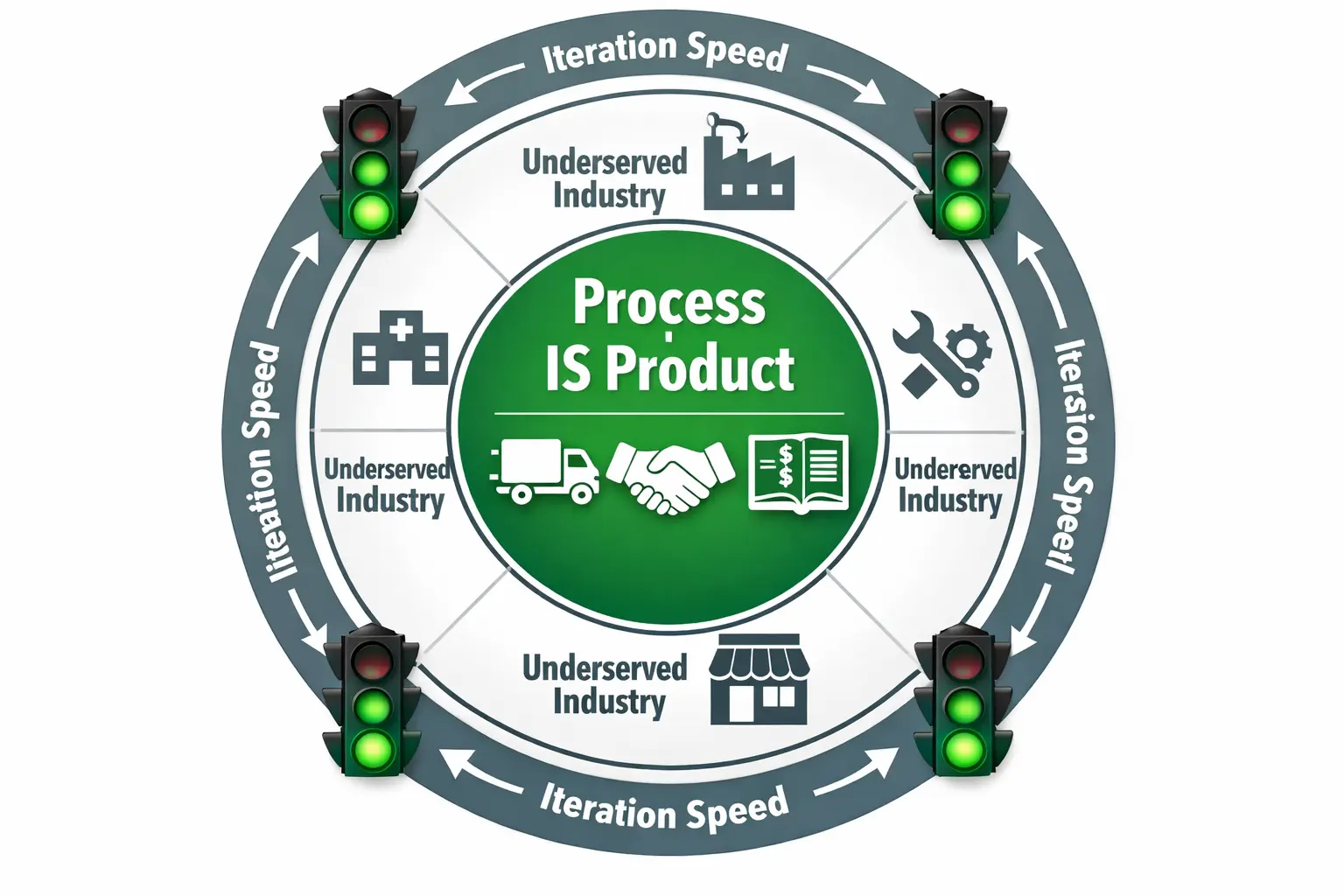
Building custom isn't ego driven when these conditions exist.
Your Process IS Your Product
Companies where operations are the product need custom ERP:
- Logistics and fulfillment companies (routing, capacity, optimization)
- Marketplaces (transaction flows, payouts, trust and safety)
- Financial platforms (ledgering, reconciliation, settlement)
- Manufacturing with proprietary processes (formulation, quality control)
If customers pay you specifically for how well you execute operations, build the systems that enable that execution.
Industry Is Underserved by Vendors
Emerging industries or niche verticals often lack good commercial options. If you're pioneering a new business model, you may need to build because vendors haven't caught up.
Warning: Make sure the industry is actually underserved, not just that you haven't looked hard enough. Sales teams love to claim uniqueness that doesn't exist.
You Need Iteration Speed Vendors Can't Match
Some businesses need to ship new operational capabilities weekly, not quarterly.
If your competitive advantage comes from rapid process innovation, vendor release cycles become a bottleneck. Building gives you control over pace.
Requirement: You must be willing to fund this as a product team with ongoing investment, not a project team that disbands after launch.
You Have the Commitment and Capability
Building custom ERP succeeds when:
- Executive leadership commits multi year funding
- You can hire and retain specialized engineering talent
- The organization has discipline around requirements and testing
- You treat the ERP platform as a product, not a project
- Business stakeholders stay engaged after go live
If any of these are shaky, reconsider building.
The Hybrid Strategy That Actually Works
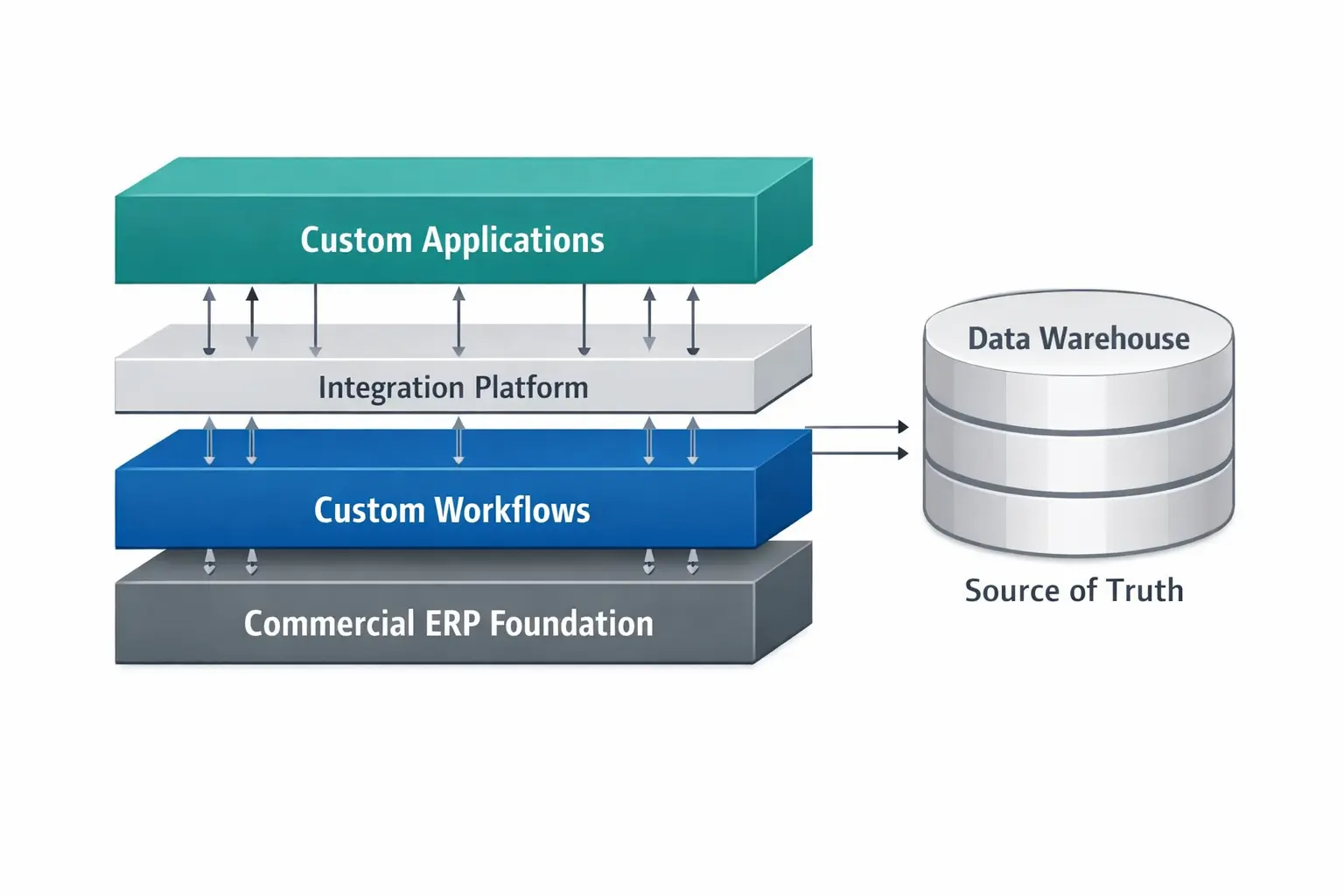
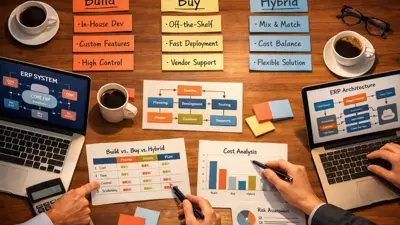
Most successful ERP strategies are hybrid. The question is how to draw the boundaries.
Build Where You Differentiate, Buy Where You Standardize
The framework is simple:
- Custom build: Processes that create competitive advantage
- Commercial buy: Processes that need to work but don't differentiate
The execution is harder. You need discipline to resist building everything.
How to Draw the Boundary
Map your value chain. For each major process, ask:
- Does this process create advantage for customers?
- Do we do this materially better than competitors?
- Will this process evolve rapidly as we grow?
- Is this process core to our business model?
If yes to multiple questions, consider building. If no to most, buy commercial.
Example for an e-commerce company:
- Build: Inventory allocation, pricing engine, fraud detection
- Buy: Accounting, HR, payroll, basic order management
Reference Architecture for Hybrid ERP
A typical hybrid stack looks like:
- Commercial ERP core: Finance, HR, procurement
- Custom workflow layer: Business specific process automation
- Integration platform: Connects commercial and custom systems
- Data warehouse: Source of truth that unifies everything
- Custom applications: Customer facing or competitive processes
The integration platform and data warehouse are critical. They prevent the Frankenstein stack where nothing talks to anything.
Governance Model
You need clear rules for what lives where:
- Decision authority: Who decides build versus buy for each domain?
- Architecture review: How do you prevent redundant systems?
- Data governance: Where does each piece of data live authoritatively?
- Integration standards: How do systems connect?
Without governance, hybrid becomes chaos.
Summary Checklist
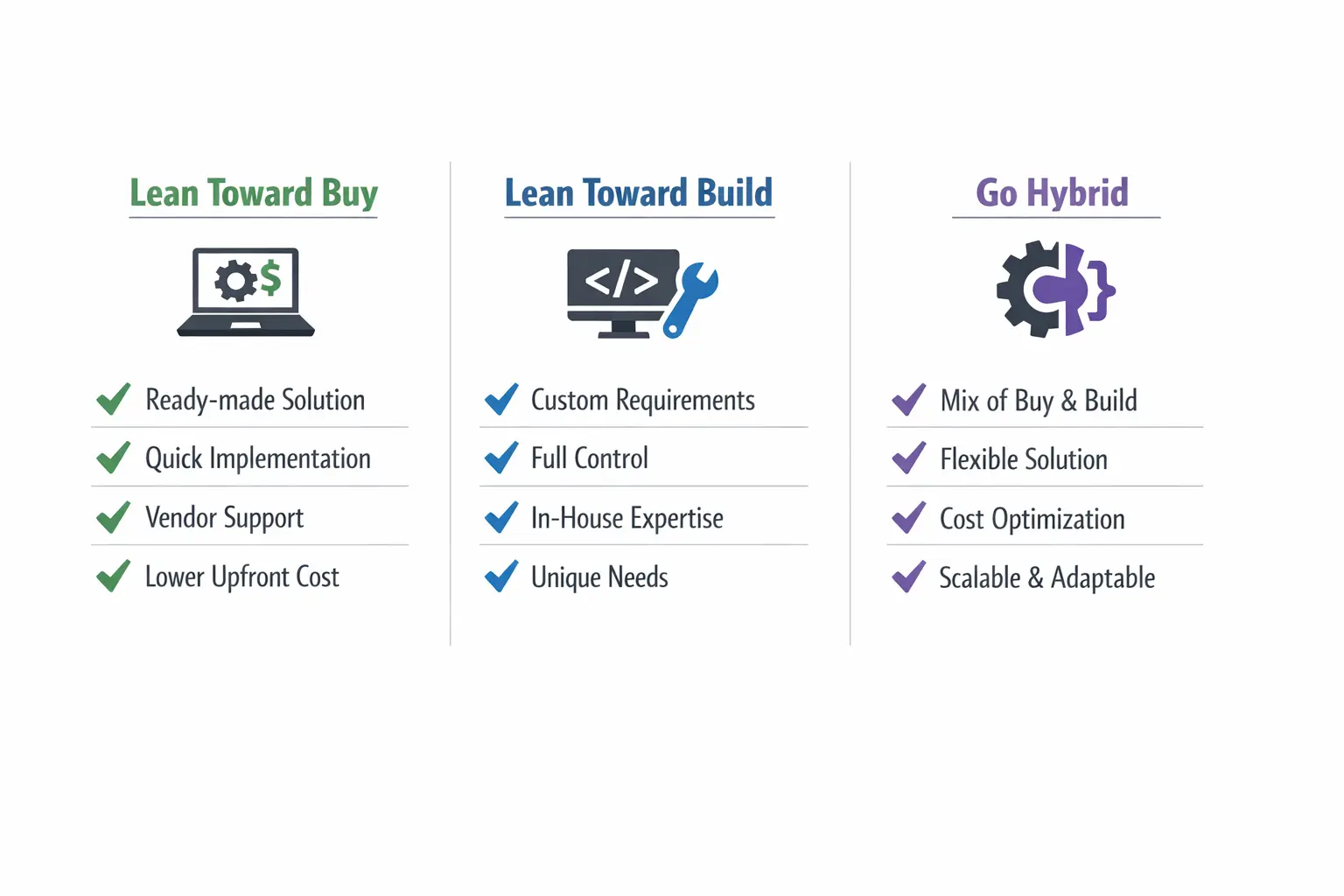
Here's the quick assessment framework for leadership teams.
Lean Toward Buy If:
- Your processes are standard for your industry
- You need deployment in under 12 months
- You're in a compliance heavy industry
- Your differentiation is not operational
- You lack ERP engineering talent
- Leadership attention should focus elsewhere
- You need predictable, vendor supported infrastructure
Lean Toward Build If:
- Your operational processes create competitive advantage
- Your industry is underserved by vendors
- You can commit multi year funding
- You can hire and retain specialized talent
- You need iteration speed vendors can't match
- You have organizational discipline to maintain custom systems
- ERP capability directly enables revenue
Go Hybrid If:
- Some processes differentiate, others don't
- You want commercial ERP for finance and HR
- You need custom systems for customer facing operations
- You can manage integration complexity
- You're willing to invest in integration platforms
- You have governance to prevent chaos
Don't Start Yet If:
- You can't articulate what problem you're solving
- Leadership is not aligned on priorities
- You don't know your total cost tolerance
- You haven't assessed internal capability honestly
- The decision is politically driven, not strategy driven
- You're hoping the software will fix organizational dysfunction
Fix these before choosing a path.
Final Thoughts: This Is About Organization Design, Not Software
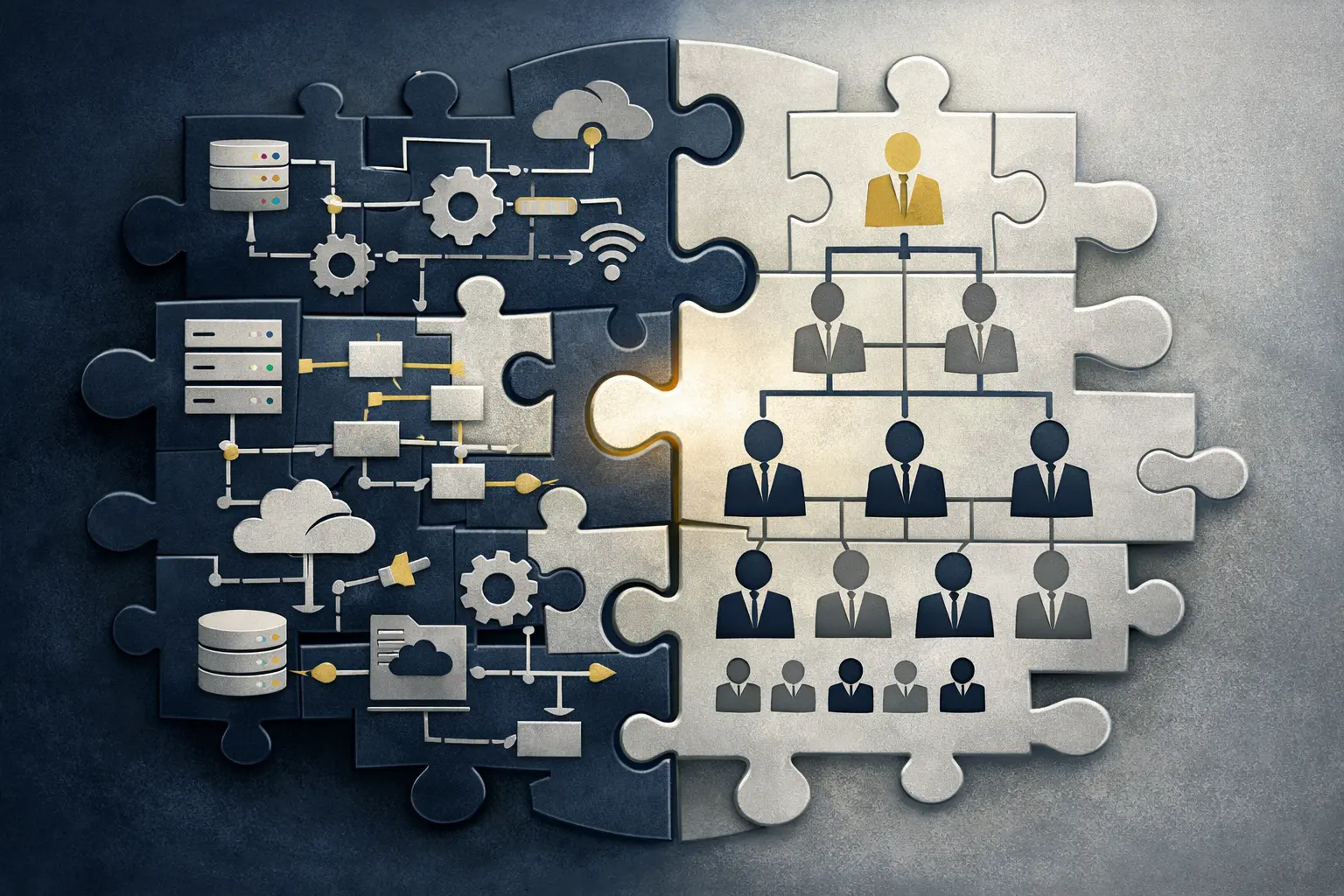
Here's what you're really choosing when you decide build versus buy ERP. You're choosing between control and convenience. You're choosing between speed and depth of fit. You're choosing between standardization and differentiation. You're not choosing whether to spend money. Both paths are expensive. You're choosing what kind of complexity you want to manage.
Most ERP failures are not technology failures. They're governance failures. They're organizations that didn't understand what they were signing up for. They're teams that made decisions for political reasons instead of strategic ones.
The companies that succeed are the ones that:
- Honestly assess their capabilities
- Align leadership on priorities
- Model total costs realistically
- Create governance that survives turnover
- Treat ERP as an organizational system, not just software
Struggling with your build vs buy ERP decision?
Don't navigate this alone. Talk to ERP strategy experts →
Whether you build, buy or blend both, the hard part isn't the technology. The hard part is the organizational commitment to make it work. Choose the path that fits your organization, your capabilities, and your strategy. Then commit to making that path work. The choice matters less than the execution. And remember: You can always revisit this decision as your business evolves. The worst ERP strategy is the one you make once and never reconsider.