AI-Powered ERP: How Intelligent ERP Is Replacing Static Workflows
Naapbooks Insights • AI-Powered ERP • 5 min read
- What Is AI-Powered ERP?
- Understanding Intelligent ERP
- Traditional ERP vs. Intelligent ERP
- Why Static Workflows No Longer Work
- How AI Is Transforming ERP Systems
- The Business Case: What the Data Actually Shows
- Core Features of AI-Powered ERP
- Benefits of AI-Powered ERP
- Industry-Specific Use Cases
- AI-Powered ERP Trends for 2026 and Beyond
- Conclusion
Every finance manager knows the feeling. A report that should take minutes takes days, because someone has to manually reconcile numbers scattered across five different modules. A warehouse team reorders stock based on last quarter's spreadsheet, not this week's demand. An HR department approves leave requests through the same rigid, multi-step chain it used a decade ago. These aren't isolated frustrations; they're symptoms of static ERP workflows that were built for a slower, less connected business world.
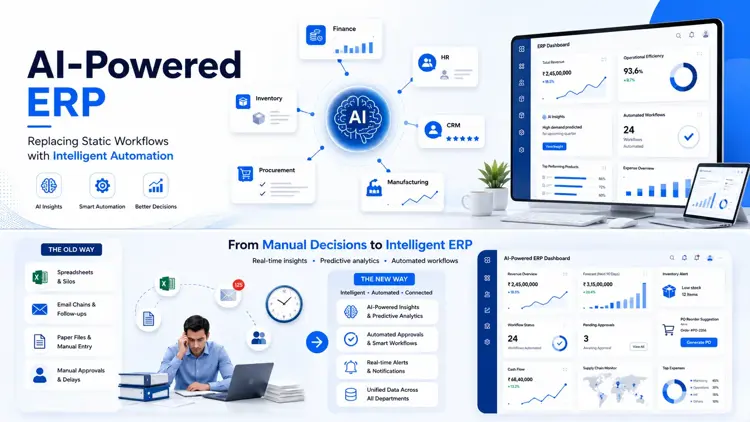
Traditional Enterprise Resource Planning software was designed to standardize processes, not to think. It follows rules exactly as programmed, regardless of changing conditions. That's where AI-powered ERP is changing the game. By embedding machine learning, predictive analytics, and generative AI directly into core business processes, intelligent ERP systems no longer just record what happened they anticipate what's next and act on it. This article explores what AI-powered ERP really means, how it differs from legacy systems, and why forward-thinking organizations are moving away from static workflows for good.
What Is AI-Powered ERP?
AI-powered ERP refers to enterprise resource planning software that integrates artificial intelligence including machine learning, natural language processing, and predictive analytics directly into core business functions like finance, inventory, procurement, and human resources. Instead of relying solely on pre-set rules and manual triggers, an AI ERP software platform learns from data patterns and adjusts its behavior accordingly.
Where a conventional system might flag a low-stock item only after inventory hits a fixed threshold, an intelligent ERP system can forecast the shortage weeks in advance based on seasonal trends, supplier delays, and sales velocity. This shift from reactive to proactive operations is the defining characteristic of ERP with artificial intelligence.
Understanding Intelligent ERP
Intelligent ERP isn't a single feature bolted onto old software it's a fundamentally different architecture. A smart ERP system continuously ingests operational data, identifies patterns, and recommends or automates decisions in real time. Think of it as the difference between a static instruction manual and an experienced operations manager who adapts based on context.
This is also where agentic AI enters the picture. Rather than simply generating insights for a human to act on, agentic ERP platforms can execute multi-step tasks autonomously from raising a purchase order to escalating a compliance risk while still keeping humans in control of critical decisions.
Traditional ERP vs. Intelligent ERP
Traditional ERP systems run on fixed workflows. A purchase requisition follows the same approval path whether it's a $200 office supply order or a $2 million capital investment, unless someone manually reconfigures the rules. Reports run on a schedule, and anomaly detection requires a human to notice it first.
Intelligent ERP flips this model. Approval paths adjust dynamically based on risk scoring, vendor history, or budget impact. Reports update continuously and can be summarized in plain language by an AI copilot the moment a stakeholder asks a question, while anomalies in spending, inventory, or production surface automatically often before they become costly problems.
The clearest distinction is adaptability. A traditional Enterprise Resource Planning platform runs the same process today as it did five years ago unless someone rebuilds it. An AI-native ERP platform refines its own recommendations as new data arrives, getting smarter with every transaction instead of staying frozen in time.
Why Static Workflows No Longer Work
Static workflows assume that business conditions stay constant, but that assumption rarely holds true anymore. Supply chains shift overnight due to geopolitical events. Customer demand fluctuates based on social trends. Regulatory requirements change faster than IT teams can reprogram approval chains.
When a workflow is hardcoded, every exception becomes a manual override, and every override adds delay, risk, and cost. Employees end up working around the system instead of through it, maintaining shadow spreadsheets and side processes that defeat the purpose of having a unified ERP platform in the first place.
Static systems also struggle with scale. As organizations grow, exceptions grow with them, and a workflow built for fifty transactions a day collapses under five thousand. Intelligent business automation solves this by absorbing variability instead of breaking under it.
How AI Is Transforming ERP Systems
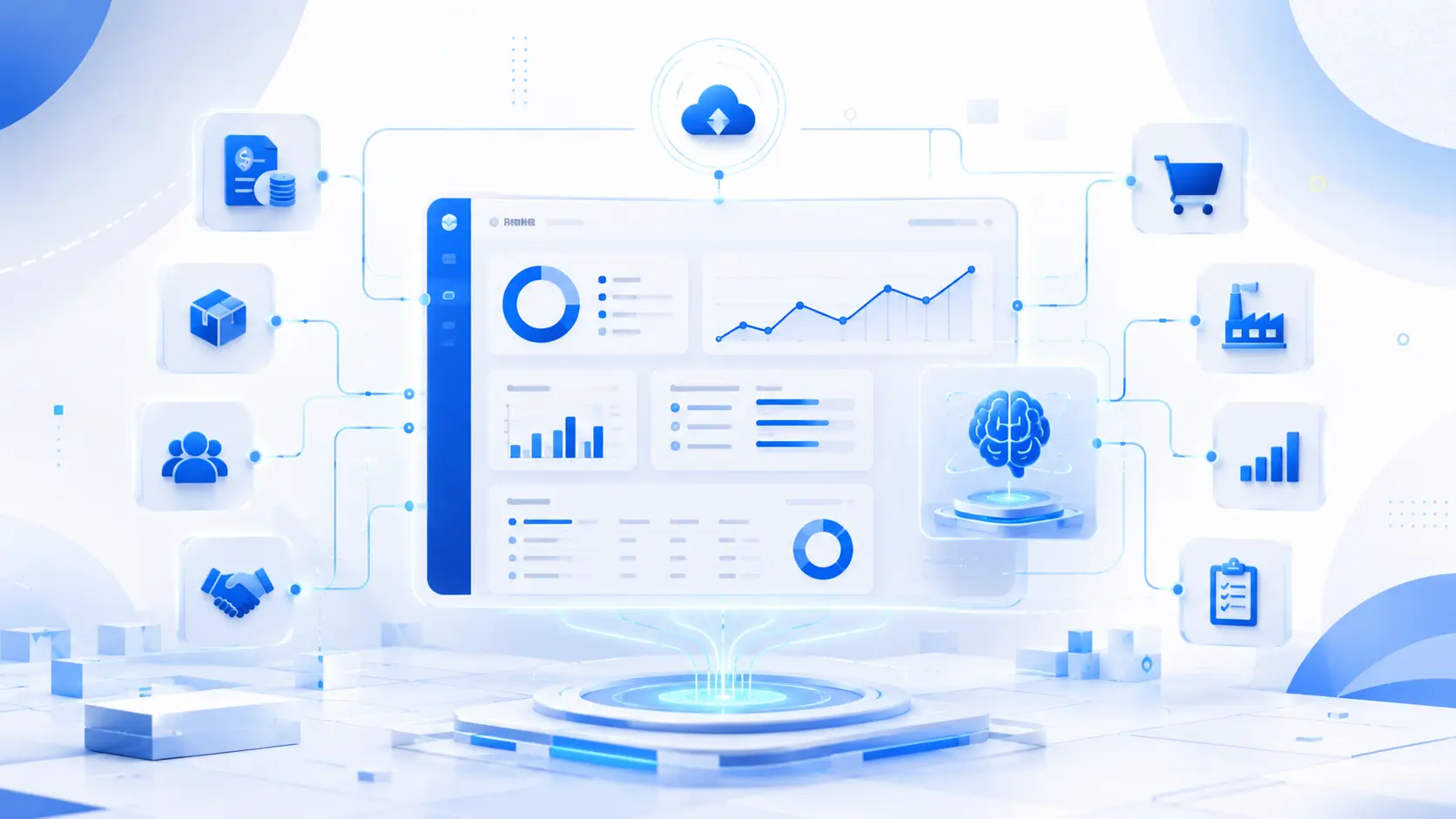
AI is transforming ERP systems in three fundamental ways: prediction, automation, and contextual decision-making. Predictive analytics allows the system to forecast cash flow gaps, equipment failures, or demand spikes before they occur. Automation removes repetitive, rules-based tasks data entry, invoice matching, basic approvals from human hands entirely.
Contextual decision-making is the newer and more powerful layer. Generative AI and large language models now allow ERP systems to interpret unstructured data, such as emails, contracts, or customer feedback, and translate it into structured actions. A procurement team member can ask an AI copilot, in plain language, which suppliers are trending toward late delivery, and get an immediate, data-backed answer instead of building a custom report.
This combination of predictive analytics, robotic process automation, and enterprise AI is what separates a modern AI ERP platform from a digitized version of a paper process.
The Business Case: What the Data Actually Shows
The shift toward AI-powered ERP isn't just a vendor narrative it shows up in the research, alongside a healthy reality check. Gartner projects the global ERP software market will grow from roughly $50.6 billion in 2023 to $78.4 billion by 2026, driven largely by cloud-based deployments.
The underlying pain point is unglamorous but universal: manual data entry, which Mint Jutras research identifies as the single biggest bottleneck reported by ERP users. Deloitte found that pairing AI-driven document automation with ERP cuts data entry time by 50 to 70 percent, which is why document and data capture is often the first automation win organizations pursue.
The agentic layer is scaling even faster. Gartner expects roughly 40 percent of enterprise applications to embed task-specific AI agents by the end of 2026, up from under 5 percent a year earlier. But speed isn't the same as maturity. Gartner also cautions that over 40 percent of agentic AI projects could be cancelled by 2027 over unclear ROI, and Stanford's AI Index notes many enterprise AI deployments still stop at augmentation rather than full autonomy.
The takeaway for ERP buyers: AI-powered ERP delivers measurable gains, but only alongside clean data and realistic timelines. Nucleus Research puts median ERP ROI timelines at around 2.5 years even without AI in the mix a useful reminder that intelligent ERP is a strategic investment, not an overnight fix.
Core Features of AI-Powered ERP
The best AI-powered ERP platforms typically share several core capabilities:
- Predictive forecasting for demand, cash flow, and inventory needs
- AI copilots that answer business questions in natural language
- Intelligent workflow automation that adapts approval paths based on context and risk
- Anomaly and fraud detection across financial transactions
- Automated document processing using machine learning and optical recognition
- Real-time dashboards powered by continuous data analytics rather than static reports
- Agentic task execution for multi-step processes like procurement or onboarding
- Natural language search across enterprise data, replacing complex query-building
These features work together to create a system that doesn't just store business data but actively interprets and acts on it.
Benefits of AI-Powered ERP
Organizations adopting intelligent ERP typically see measurable improvements across several areas:
- Faster decision-making, since insights are generated instantly rather than compiled manually
- Reduced operational costs through automation of repetitive administrative work
- Improved accuracy, with AI catching data entry errors and inconsistencies humans often miss
- Better forecasting, helping teams avoid stockouts, overproduction, or cash shortfalls
- Higher employee productivity, as teams spend less time on manual reconciliation and more on strategic work
- Stronger compliance, since AI can continuously monitor transactions against regulatory requirements
- Scalability, allowing the system to handle growing transaction volumes without proportional increases in headcount
These AI ERP benefits for businesses compound over time, since every automated decision also generates data that improves future predictions.
Industry-Specific Use Cases
Manufacturing
AI-powered ERP for manufacturing enables predictive maintenance, flagging equipment likely to fail before a breakdown halts production. It also supports smart manufacturing by dynamically adjusting production schedules based on real-time material availability and demand signals.
Finance
AI-powered ERP for finance automates reconciliation, detects unusual transactions that may indicate fraud, and improves cash flow forecasting. Financial automation reduces the manual burden of month-end close, often cutting the process from days to hours.
Retail
Retailers use AI-powered inventory management to predict demand at the SKU level, adjusting purchasing and replenishment automatically based on seasonality, promotions, and local trends rather than static reorder points.
Healthcare
Healthcare organizations rely on intelligent ERP for supply forecasting, staff scheduling, and compliance tracking, where errors carry significant operational and patient-safety consequences.
Human Resources
AI-powered HR ERP streamlines recruitment by matching candidates to roles, automates onboarding workflows, and flags attrition risk based on engagement and performance data patterns.
Supply Chain
AI-powered supply chain ERP improves supply chain optimization by predicting shipment delays, recommending alternate suppliers, and adjusting logistics plans in response to real-time disruptions.
AI Workflow Automation Explained
AI workflow automation goes beyond traditional robotic process automation, which simply follows scripted steps. Instead, it interprets context. A traditional automation script might route every invoice above $10,000 to a manager. An AI-driven workflow, however, might also factor in vendor reliability, contract terms, and current budget utilization before deciding whether that invoice needs escalation at all.
This is ERP automation software that improves with use. Each processed transaction feeds back into the model, refining future recommendations and gradually reducing the need for manual intervention across the organization.
Common Challenges and Solutions
Data quality remains the most common obstacle to AI ERP implementation. The fix is a dedicated data governance process that standardizes formats and removes duplicate records before AI models train on them.
Employee resistance is another frequent challenge, often rooted in fear that automation will eliminate jobs. Transparent communication about how intelligent business automation shifts human focus toward higher-value work rather than replacing people outright helps ease the transition.
Integration complexity can also slow adoption, especially for organizations running legacy systems alongside newer cloud ERP platforms. Experienced implementation partners and AI ERP software with strong API support reduce this risk significantly.
AI-Powered ERP Trends for 2026 and Beyond
Looking ahead, agentic ERP systems capable of autonomously executing multi-step business processes are expected to become mainstream rather than experimental. Generative AI will move beyond chat-based copilots into deeper workflow generation, where systems can draft entire process templates based on a plain-language business goal.
Industry analysts, including Gartner and McKinsey, have both pointed to intelligent automation and enterprise AI as top priorities shaping digital transformation strategies through the next several years.
Expect tighter integration between ERP platforms and broader enterprise intelligence tools, along with growing emphasis on explainable AI, so business leaders can trust and verify automated decisions.
Conclusion
Static ERP workflows were built for a business environment that no longer exists. Today's organizations need systems that anticipate disruption, adapt in real time, and reduce the manual burden on stretched teams precisely what AI-powered ERP delivers.
Whether it's predictive maintenance in manufacturing, automated reconciliation in finance, or smarter inventory decisions in retail, the message is consistent: intelligent ERP is a competitive necessity now, not a future concept. Organizations that adopt AI-driven ERP solutions today will set the pace for their industries tomorrow.